
That’s why a growing number of hotels are doing something radical — taking the internet away, on purpose. From Scottish retreats with signal-proof rooms to Mediterranean farmhouses that trade screens for starlight, “digital detox” is no longer a whispery wellness trend. It’s a booking category. It’s a relief valve. It’s the story of a year when real rest suddenly mattered again.
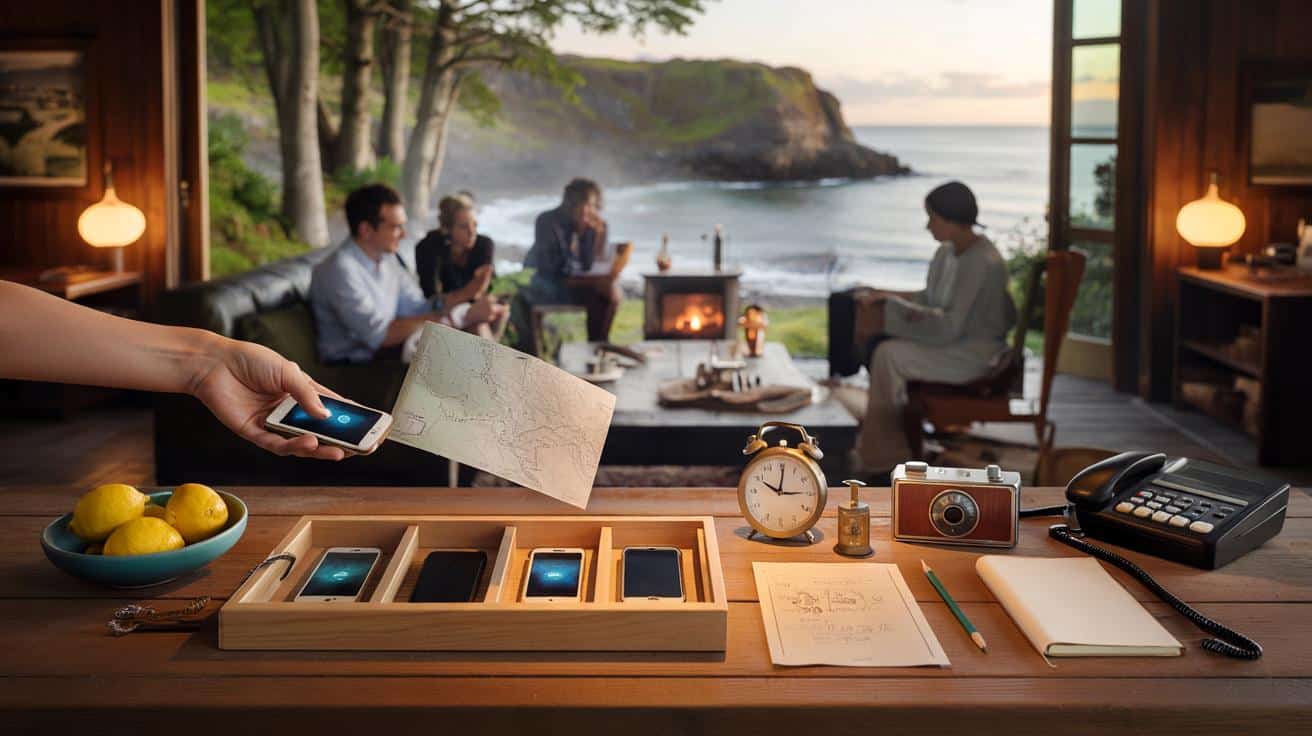
I arrived on a wet Friday, phone hot from emails, thumb twitching at phantom notifications. At reception, a wooden tray sat beside a bowl of lemons. “Phones sleep here,” said the hand-drawn note, the kind a friend would write. I placed mine down and felt ridiculous, then strangely light. The receptionist slid a paper map across. Outside, wind pushed through beeches, somewhere a bell chimed. In the lounge, no one stared at their lap. Someone laughed. The silence had weight. It felt like a dare.
The new status symbol: not being reachable
There was a time when showing up meant showing off the latest tech. Now, the flex is a holiday where your browser can’t follow. In an age of infinite pings and bottomless feeds, absence has become aspirational. A certain type of hotel has leaned into this by making the off-switch part of the experience. The pitch isn’t monastic. It’s simple: leave buzzing behind, reclaim your attention, and see what returns.
I’ve seen it at a clifftop lodge in Cornwall where guests seal phones into timed pouches, then queue for the outdoor bath under a sky you stop to notice. I’ve heard it from a city lawyer who booked a 72‑hour blackout after waking one morning with his thumb swiping mid-dream. Search interest in “digital detox” keeps creeping up, and hoteliers whisper of waitlists for rooms with no signal. The irony isn’t lost on anyone.
Hotels read the mood fast because the market speaks. When attention is the commodity, environments that protect it feel rare — and we pay for rarity. This isn’t anti-tech puritanism. It’s a design choice: fewer prompts, clearer margins, better sleep. **The real luxury isn’t a bigger room; it’s a quieter mind.** Let’s be honest: nobody really does this every day. Two nights away from the scroll can hit like a power cut, then a sunrise.
How digital detox stays actually work
Good detox hotels make it easy to succeed. The best ones start with friction: a lockbox at check-in, a timed pouch, or a “signal-light” room tucked behind thick stone. They replace the urge to reach with low-stakes rituals — tea by the fire, a walk mapped on paper, a kitchen garden tour. You get analogue toolkits: alarm clocks, pencils, actual novels. Staff cue you into a slower rhythm the way a maître d’ cues a dining room.
Here’s a playbook that works. Set a single check-in window with the outside world, then write it down at reception. Swap your phone for a disposable camera and a notebook, because making is stronger than resisting. Tell your people where you’ll be, and give the hotel’s landline for emergencies. We’ve all had that moment when the mind lifts its head from the feed and wonders what else it can hold. That feeling is the point, not a problem to fix.
There are traps. Sneaking a “just in case” device ruins the spell, like bringing crisps to a supper club. Don’t schedule every minute; leave blank space, then notice what fills it. **Rest isn’t a task, it’s an environment.** As one manager told me:
“We don’t confiscate technology; we curate the conditions where your phone becomes boring.”
Think of it as set and setting. The right cues help:
- A visible phone-free zone that feels welcoming, not stern.
- Analogue anchors: board games, sketch pads, maps you can fold.
- Rhythms that cradle the day — a bell for supper, a dawn swim.
- Safety nets: a landline, a printed weather sheet, a note for loved ones.
What unplugging gives back
Something funny happens when your pocket stops vibrating. Conversation lengthens. Food tastes louder. You start noticing tiny edits to the world: the dark seam of a storm cloud, the warm slur of a cello in the next room, your own thoughts without narration. **Digital detox hotels aren’t a moral stance; they’re a permission slip.** Not to be perfect, just to be present. This year the cultural spell finally cracked. We realised that every time we look down, we trade a slice of attention we will never see again. A short reset won’t fix a system, but it can reset a self. Maybe you’ll return and prune your notifications. Maybe you’ll call your mum. Maybe you’ll book another room with nothing in it but light. The point isn’t less technology. The point is more life.
| Key point | Detail | Interest for the reader |
|---|---|---|
| Off is the new luxury | Hotels sell protected attention: lockboxes, signal-light rooms, analogue kits | Learn how spaces can help you rest without willpower |
| Design beats discipline | Rituals and cues replace sheer self-control during a stay | Practical ideas you can steal at home |
| Plan the edges | One daily check-in window, emergency landline, paper maps | Leave feeling calm, not anxious about missing out |
FAQ :
- What exactly is a digital detox hotel?A place that limits or removes internet access and phone use, replacing it with analogue comforts, nature, and structured calm.
- Do they really take my phone away?Many use lockboxes or timed pouches at check-in, though policies vary. You can usually access your device for emergencies.
- Will I be bored without my screen?For the first hour, maybe. Then the body lands. Activities, walks, and simple rituals tend to fill the space in kinder ways.
- What if I need to be contactable?Hotels provide a landline and can pass on messages during a set window. Agree rules with loved ones before you go.
- Are these stays expensive?Prices range widely. Country inns often offer affordable packages midweek, while boutique retreats price like luxury wellness breaks.






Honestly, this reads like a deep breath. The idea that “the real luxury is a quieter mind” hits hard after a year of constant pings. I love the design-over-discipline angle—rituals, paper maps, timed pouches. Makes rest feel intentional, not performative. Bookmarking this for my next trip.
Isn’t this just luxury repackaged—paying more for less? Feels a bit ironic to sell silence while many can’t afford time off. I’m not anti-detox, but I’d like to see accessbile, community versions too, not just boutique retreats. Otherwise it risks being wellness theater.