
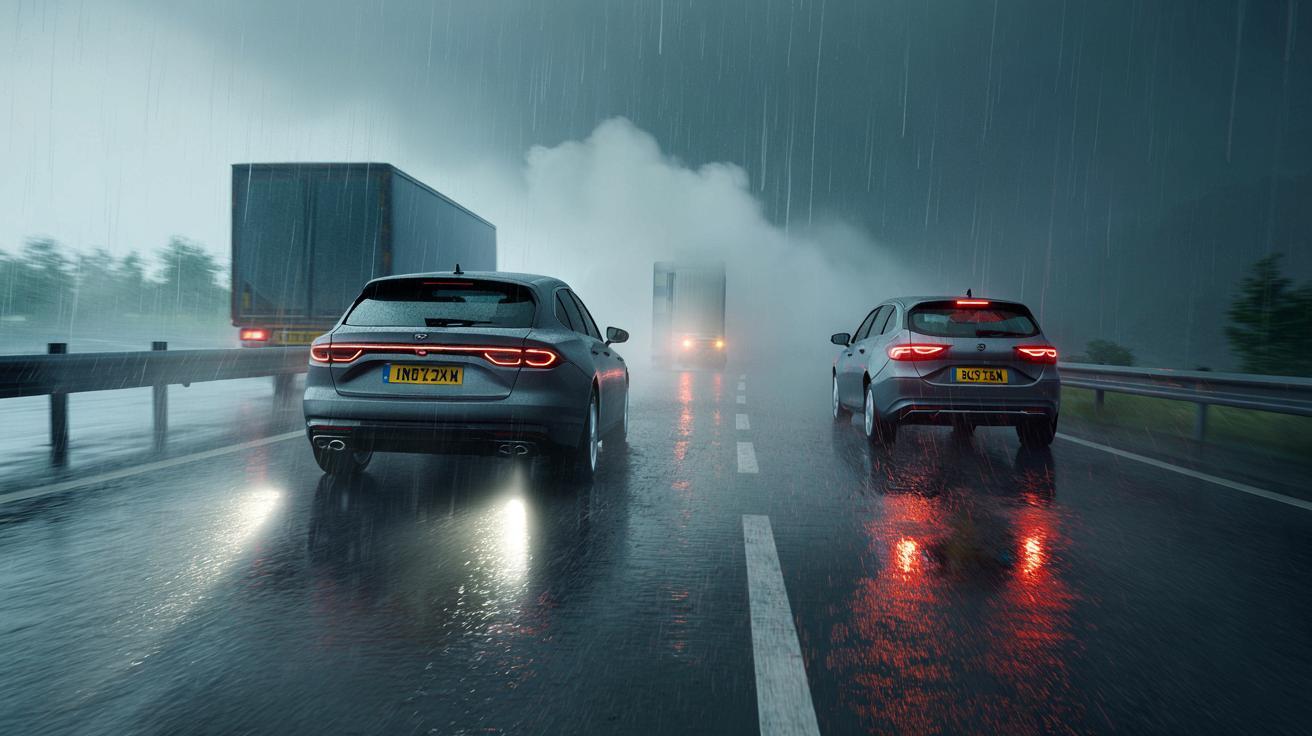
Driving in heavy rain turns motorways into moving grey tunnels and city streets into mirrors. You see the spray hanging in the air, wipers thumping, and a strange gloom that makes distances lie. The question isn’t whether you can drive through it. It’s whether others can see you at all.
A lunchtime run for bread, three turns from home, and the road darkened as if a dimmer switch rolled back. Wipers on full, hands steady, and then that tell‑tale moment: a lorry ahead disappeared into its own spray, tail-lights smothered and faint. Somewhere behind, a hatchback sat on daytime running lights only — bright eyes up front, nothing glowing at the rear, almost ghosting into the grey. I could feel the tension in my shoulders growing, along with a thought I didn’t want to test.
When the rain gets heavy, the right light setting isn’t a nice-to-have. It’s the small decision that flips you from “there” to “visible”. And it’s more specific than most drivers think.
The light setting that actually cuts through a downpour
When the sky opens, the most effective choice is simple: switch on dipped headlights manually. Not auto. Not sidelights. Not high beam. Manual dipped headlights turn on both your front lights and your rear lamps, which is the bit that matters in spray. Daytime running lights can leave your rear completely dark, and that’s where people are aiming their stopping distances. The beam pattern of dipped headlights also sits low enough not to flare back at you in the rain, so your own view stays cleaner. One twist of the stalk changes your presence on the road more than a thousand cautious glances.
Here’s the pattern I see, especially on bright rainy days: auto lights stay off because the sky still reads as daylight, so the back of the car is invisible through spray. Then a motorway queue builds, a brake light flashes late, and everything tightens. Research out of the US found fatal crash risk jumps in heavy precipitation; British roads echo the same logic when water piles up and visibility shrinks. Stopping distances double on wet tarmac, and that’s before aquaplaning nudges in. Visibility isn’t a vibe. It’s physics and red lamps.
There’s a reason the Highway Code spells this out. Dipped headlights are the default in reduced visibility, including heavy rain. The beam is designed to punch a clean, low stripe under the water haze without blinding oncoming traffic. High beam just bounces light off raindrops back into your eyes. Sidelights barely register in daylight. Fog lights have their place, yet they’re not an all-weather substitute: front fogs are cut wide and low, and rear fogs are intense enough to dazzle when the air clears even a little. **The sweet spot is manual dipped headlights, on early and left on until the world sharpens again.**
How to set it, and the pitfalls that catch drivers out
Adopt a simple habit: rain starts, dipped headlights go on by hand. Treat it like the wipers. Twist the light switch from auto to headlight, or pull the stalk to the dipped position, and leave it there. If visibility is seriously reduced — think less than 100 metres, or when spray swallows tail-lights — add rear fog briefly, then turn it off as soon as you can see a reasonable distance. Keep front fogs for very thick spray or mist on slower roads, not as a fashion statement at 70 mph. The idea is to be seen without turning the motorway into a science experiment in glare.
Common slip-ups come from good intentions. People lean on DRLs, not realising they don’t light the rear. Auto settings feel clever, then miss the cue because rain darkens the air without darkening the day. Rear fogs feel like protection, but that punchy red can mask brake lights and tire the eyes of the driver behind. We’ve all had that moment when the car ahead vanishes into a wall of spray; the next second should not be a guess. Be kind to your future self and give everyone around you a bold, readable profile.
Let’s talk behaviour we see everywhere and quietly copy. Car in spray, DRLs on, no rear lights, phone on the dash, the occasional hazard light blink to say “sorry about the puddle”. **Let’s be honest: nobody checks their light logic every single day.** The fix is to make one decision that sticks: dipped on, auto off, then reassess in five minutes when the rain shifts.
“In heavy rain, visibility at the back matters most. If your rear lights aren’t lit, you’re gambling with someone else’s stopping distance.”
- Dipped headlights on manually: lights front and rear, low glare.
- Use rear fog only when visibility is under roughly 100 metres, then switch it off.
- Avoid high beam in rain — it reflects and reduces your own view.
- Don’t rely on DRLs — many cars have no rear illumination with them.
- Check auto lights in daylight rain — they often stay off when you need them.
Small choices, big margins
There’s a quiet pleasure in driving well in foul weather. You’re reading the road, leaving a longer gap, and sending clear signals long before anyone needs to ask. Manual dipped headlights fold into that rhythm. They don’t shout. They just mark you out cleanly in the mess. *In thick spray, DRLs are not enough.* If your car has an “Auto” icon glowing on the light knob, consider that a helpful servant, not a captain. You’re still the one who sees the world as it really is through the glass.
| Key point | Detail | Interest for the reader |
|---|---|---|
| Use manual dipped headlights in heavy rain | They illuminate front and rear without glare, improving how others judge distance | Fewer near-misses in spray and a calmer drive |
| Don’t trust auto lights or DRLs alone | Auto may stay off in daylight rain; DRLs often don’t light the rear | Prevents “invisible rear” syndrome that leads to shunts |
| Reserve fog lights for truly poor visibility | Rear fog under ~100 m only; turn it off when conditions improve | Avoid dazzling and keep your brake lights obvious |
FAQ :
- Should I ever use high beam in heavy rain?Not really. High beam scatters off raindrops and reduces your own vision, while adding glare for others. Dipped beam gives a clearer, lower stripe of usable light.
- Are daytime running lights enough in a downpour?No. Many DRL setups light the front only. Your rear stays dark, which makes you vanish in spray. Switch to dipped headlights so the back of your car glows red and readable.
- When is it right to use rear fog lights in rain?Use them when visibility is severely reduced — around 100 metres or less — such as in thick spray. Turn them off as soon as visibility improves so you don’t mask your brake lights or dazzle.
- Do auto lights work in rain during the day?Sometimes, but not reliably. Rain can dim contrast without convincing the light sensor it’s “night”. Take control and set dipped headlights by hand when the weather turns.
- What else should I do alongside the right light setting?Leave a bigger gap, smooth your inputs, and keep tyres and wipers in good shape. **Small margins multiply in the wet, and your lights are the first margin other drivers see.**






Thank you for calling out the DRL trap. I’ve lost count of cars vanishing into spray with no rear lights. Switching to manual dipped as soon as the wipers go fast has defintely cut my stress on the M25. Also appreciate the note about rear fog—use it when visibility is under ~100 m, then switch it off. Clear, practical advice I can actually use on a grim commute.