
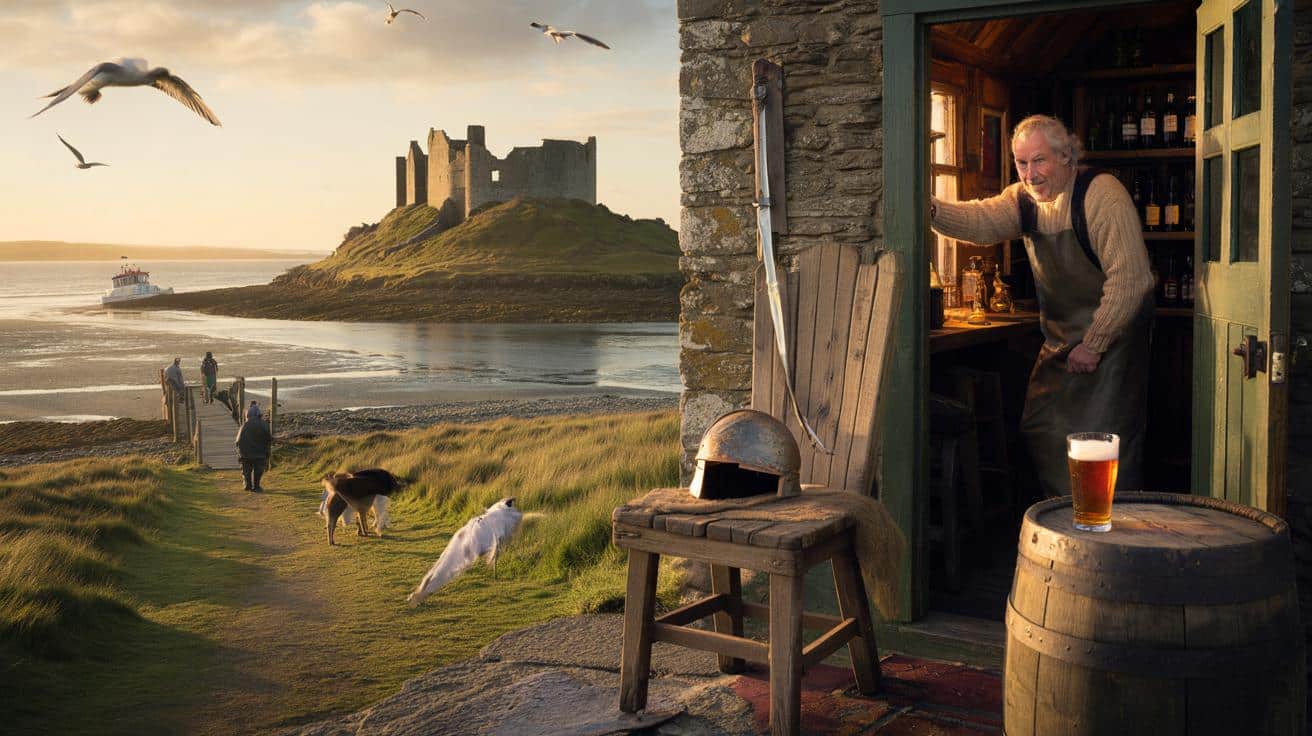
A handful of miles off England’s north-west coast sits a speck of land with a habit of rewriting the rules: a population of roughly twenty people, a 14th‑century castle, and a pub where the landlord is crowned King. The kind of place that makes your maps feel a bit too tidy.
Gulls wheel overhead, the ruins of a castle lift from the grass like a half-remembered story, and the Ship Inn’s sign creaks in the wind. Someone on the jetty waves, not because it’s polite, but because that’s what you do when there are so few of you.
By the bar hangs a dented helmet and a nicked sword, as unbothered by ceremony as the islanders themselves. This is Piel Island, a tidal world tethered to Roa Island by weather and whim. The “King” is pouring pints. The crown hangs by a nail.
Where twenty people share one tide — and a crown
On Piel, small talk is weather, tide, and whether the generator feels like being friendly. You can count the residents on two hands and borrow a couple of fingers, a number that swells on sunny weekends and sinks on sleety Tuesdays. **This is not a theme park.** Real lives are happening here: caretaking, mending fences, clearing windblown sand from doorways.
Walk the grassy track past the pub and the castle comes into perfect view, its stones freckled with lichens, its silhouette crisp against the Irish Sea. Once, the monks of Furness Abbey built this outpost to guard their trade; centuries later, visitors tuck into chips as the tide curls back. A seal blinks from the shore like a fisherman on tea break. Someone’s dog trots ahead, sure of the path, sure of the people.
The “King of Piel” is today’s landlord of the Ship Inn, a winking title that reaches back to local lore and a brush with history. In 1487, the pretender Lambert Simnel landed nearby, a bootprint in the sand of English power that never quite set. The coronation now is a pint-soaked rite of hospitality: a battered helmet, a wooden throne, a promise to keep the place welcoming. It’s playful, but it holds a quiet truth—here, people matter because there aren’t many of them.
One night, one crown, one story you’ll tell forever
Stay late enough, and the island turns theatre. The ferry’s gone, the light softens, and the pub door swings to keep the warmth in. If a coronation is on, the room rearranges itself around an old chair—part throne, part joke, all community. Kneeling is optional, laughter is not. You might be “knighted” if you buy the house a drink, a salty tradition that moves faster than the tide and tastes like ale.
It’s easy to romanticise a place like this. So here’s the backbone: stocked fridges arrive by boat; storms strip paint; bins must be ferried off; the generator coughs at awkward hours. Locals roll their eyes at phones that don’t quite load and tourists that do. Let’s be honest: nobody actually does that every day. The magic isn’t a filter, it’s a rhythm. The sea decides, and everyone listens.
Ask an old hand how it works and the answers come unvarnished. The sea decides, and everyone listens. The King? A caretaker with extra stories. The crown? Invented gravitas, and yet somehow, it fits.
How to visit without spoiling the magic
First, think like a tide. Ferry crossings run from Roa Island when weather and water agree, generally spring to early autumn, with a chalkboard timetable that acts more like guidance than law. Bring cash; cards behave like nervous tourists out here. Pack layers, and a torch if you’re camping. Eat at the Ship Inn, walk the castle’s edge at low tide, and say hello—you’re not a stranger for long on a twenty-person island.
Keep your footprint small. Leave no trace, close gates, and keep dogs on leads around nesting birds. Resist the urge to drone—both literally and figuratively. Don’t try to walk the sands unless you know the safe line and the tide tables; stories of quicksand and fast floods aren’t quaint warnings, they’re lessons. **Respect the tide or don’t come.** Check the pub’s hours before you pitch up with a hungry crew. Kindness travels here quicker than gossip.
If the coronation happens, watch, laugh, raise a glass when asked. It’s not cosplay; it’s community with a sense of humour. One islander put it simply:
“We keep the crown light so the island can carry it.”
- Getting there: small ferry from Roa Island, days and hours shift with tide and weather.
- Season: usually April–September for regular crossings; winter is a different beast.
- Food and drink: the Ship Inn is the island’s social heart—check hours.
- Sleeping: basic camping near the pub; bring warm kit and pack out what you bring in.
- Rituals: “King of Piel” is ceremonial; “knights” are made with banter and a round.
- Wildlife: seals, shorebirds, and patient gulls—keep distance and give them space.
Why a tiny island with a King sticks in your head
Because scale is a trick. On paper, Piel is a few fields, a pub, a ruined castle, and twenty or so souls. On your skin, it’s wind and quiet and the warm knock of a pint on wood. On your conscience, it’s an invitation to live more locally, even for an afternoon. People will tell you it’s quirky, which is true, but that word misses the weight. **Small places carry big stories.** The crown is a wink at power and a salute to care. We’ve all had that moment when a trip lingers for months, turning up in conversations you didn’t expect. This is one of those.
A fragile crown in a rising sea
Off-grid islands feel the world sooner. Storms hit harder, prices float higher, and visitors are both lifeline and strain. Piel holds together with kindness, humour, and a knack for fixing things with what’s at hand. It’s British in a way that’s older than slogans: weather-led, public-house-centred, practical to the bone. You come for the headline—an island of twenty with its own King—and leave noticing how the ferry skipper’s handshake says as much as any coronation. If there’s a lesson, it’s that communities get to choose their rituals, and that choice can feel like a north star. Share the tale, go softly, and let the tide write your timing.
| Key point | Detail | Interest for the reader |
|---|---|---|
| Tiny island, big tradition | Piel’s landlord is crowned “King of Piel,” a community rite tied to a storied pub | A rare, living slice of folklore you can witness without a museum ticket |
| Getting there | Ferry from Roa Island runs seasonally and by tide; walking the sands is risky | Plan the trip well and avoid the classic tidal mistakes |
| What to do | Castle ruins, pub evenings, seals and shore walks; low-impact camping by the inn | A slow, memorable day out that feels like stepping into a postcard |
FAQ :
- Is there really a “King” on Piel Island?Yes—it’s a ceremonial title held by the landlord of the Ship Inn, marked by a light-hearted coronation with a helmet, a sword and a seat that doubles as a throne.
- How many people live on Piel Island?Around twenty, fluctuating with seasons and work. In winter, the number can be lower; on bright summer days, it feels higher thanks to visitors.
- How do I get to Piel Island?Take the small ferry from Roa Island when tide and weather allow, typically spring to early autumn. Timings can change daily—check locally on the day.
- Can I stay overnight?Yes, usually by pitching a tent near the Ship Inn in the designated area. Facilities are basic—think torchlight, warm layers, and pack-it-out habits.
- Can I be “knighted” on Piel?Sometimes. If the mood is right and the room is game, visitors are playfully “knighted”—often after treating the bar. It’s informal, good-natured, and entirely optional.





So the landlord is literally the King of Piel? Do they accept tribute in chips and a round of ale, or must I kneel frist?
Charming, but I worry about the enviromental footprint: diesel generator, rubbish ferried off, more visitors after pieces like this. How do locals balance income with impact when storms and tides already tax the place?