
Here’s how to catch it at its best, where to look, and the little tricks that turn a quick glance into a “did you see that?” moment.
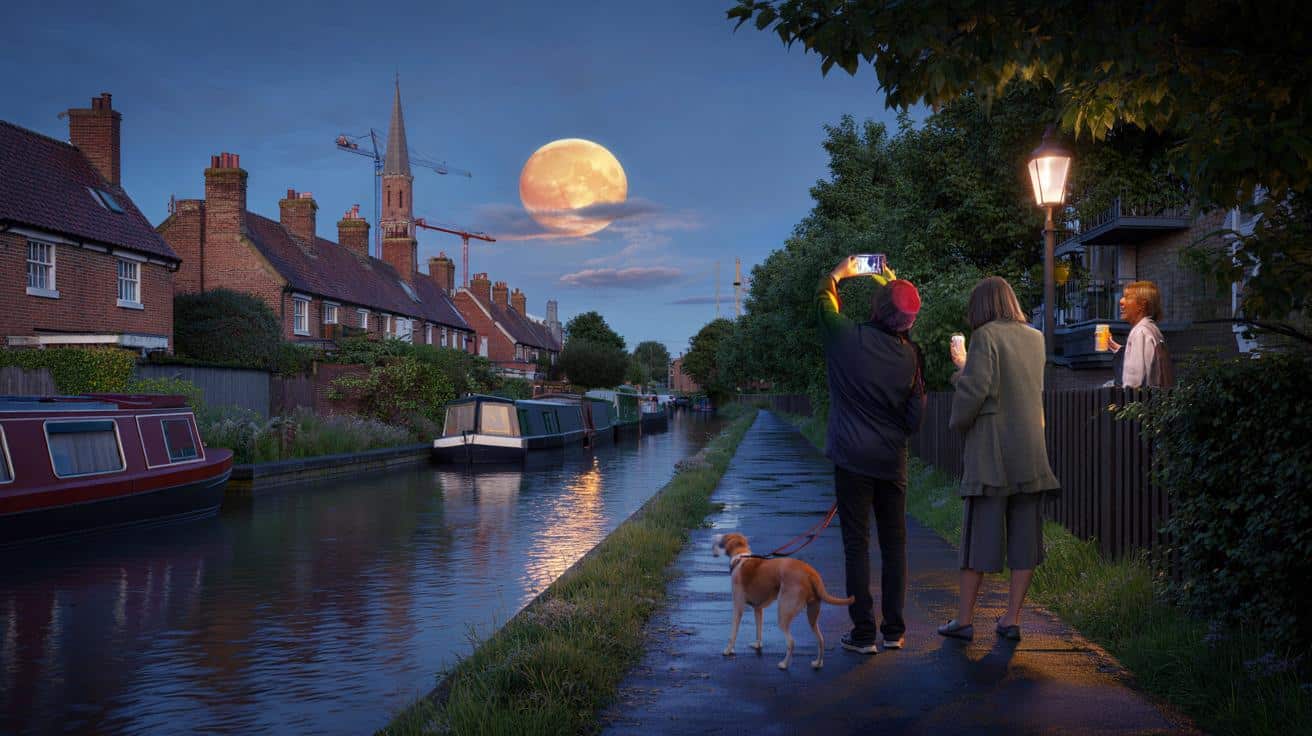
The canal path smelled like wet leaves and petrol when the text pinged: “Look east.” I paused, dog lead looped around my wrist, and there it was — a pale coin shouldering above the rooftops, fat and oddly close, making the parked cars look like toys. A couple on the towpath slowed; the man raised his phone, then laughed at the blur, then tried again with elbows tucked in like a steadying tripod.
A jogger stopped. A neighbour waved from a balcony with a mug. The moon kept coming, gold thinning to cream as it lifted clear of the chimneys, and for a few quiet minutes the city felt politely dimmed. The trick is timing.
Why this supermoon will look and feel different
Step outside just after dusk and you’ll notice the supermoon before you’re ready: bigger-looking, brighter, and embarrassingly photogenic when it’s skimming low over rooftops. It’s not theatre lighting; it’s geometry. The Moon is near perigee — the close point in its oval orbit — which makes it appear a touch larger than a regular full Moon, and that subtle difference lands as a gut feeling when it’s sitting on the horizon next to familiar buildings.
Expect a warm hue at first. That’s Earth’s atmosphere scattering the bluer light, leaving you with honey and apricot tones that photographers chase for years. *The first 30 to 60 minutes after it clears the horizon are pure magic.*
“Rare” doesn’t mean once-in-a-lifetime. Supermoons turn up a few times most years, yet the combination of a Friday night, decent evening hours, and the Moon rising soon after sunset is unusually friendly for UK eyes. We’ve all had that moment when a clear evening arrives exactly when you’re finally free, and suddenly the sky feels like it’s on your side.
If you’re somewhere coastal you might notice higher-than-usual spring tides tugging the sea line a little taller, while inland the brighter light tends to pull people outdoors without a second thought. It’s the kind of night where dog walkers become temporary tour guides.
Here’s what’s actually happening. At perigee the Moon can sit roughly 30,000 to 50,000 kilometres closer to Earth than at apogee, which makes it look up to about 7% larger in diameter and roughly 15% brighter to our eyes. On paper that sounds modest, yet our brains compare the rising Moon to buildings, cranes and tree lines, which exaggerates the sense of scale.
That low-horizon “wow” isn’t the Moon changing size; it’s your mind playing a useful trick. Mix in a bit of atmospheric refraction — bending the light near the horizon — and you get that stretched, shimmering edge that makes it feel almost touchable.
Best viewing times, where to look, and the simple hacks that work
Circle two easy windows. The first is the hour after moonrise on Friday, when the supermoon lifts in the east and glows deepest over rooftops and ridges; the second is the final hour before moonset early Saturday, low in the west with quieter streets and cooler air. Across the UK that first window will begin shortly after local sunset, so the simple rule is this: check your local moonrise, then be in place 15 minutes before it happens. **Best viewing times** are the first 20 to 40 minutes after it clears the horizon.
If you want the supermoon to look huge, give it a frame. Find a vantage with a long view to the eastern horizon for the rise — a park slope, a canal towpath, the end of a pier, a hill above your estate — and position a church spire, crane or skyline edge between you and the Moon. That low angle is where the drama lives, and it’s kinder on phone cameras too, because the sky is darker and the Moon less blinding.
Common pitfalls are easy to dodge. People look too early, stare in the wrong direction, or stand under a streetlight that washes out the contrast. Streetlamps lie; step a few metres into shade and the Moon will pop. Let’s be honest: nobody fine-tunes their sky plan every day. So pick one direction — east after sunset, west before dawn — and let the Moon come to you rather than chasing it across town.
Clouds get all the blame, but gaps are your friend; patient five-minute waits often pay off. If it’s hazy, the Moon can actually look moodier and more cinematic, with softened edges and a bigger “theatre” feel, like someone turned up the dimmer switch on the night.
Here’s a simple pocket plan for phones and eyes:
“Stand where you can see a long, clean horizon, look east fifteen minutes after sunset, and give yourself a full half-hour to watch it climb. The show isn’t a moment — it’s a slow reveal.”
- Find your spot by day, so you know your sightlines and where the streetlights are.
- If you’re snapping with a phone, tap to focus on the Moon, slide exposure down until the craters appear, and lock it.
- Tuck elbows in or lean on a wall; even a wool hat over a railing makes a handy “tripod”.
- Switch to 3× zoom or more to compress the scene and make the Moon sit bigger against buildings.
- Pack a warm layer and a small torch; a thermos never hurts on a long look.
A night to share, a light to remember
Some skies come and go without asking much of you; this one offers itself up at a civilised hour and rewards anyone who gives it ten honest minutes. You’ll step outside for the size, then stay for the colours, and by the time it’s cleared the roofline you’ll spot the subtler things — the way shadows sharpen, how the local fox moves differently in that pearly light, the way conversation softens on pavements.
There’s something democratic about it. No ticket, no queue, no secret vantage point that isn’t also yours. If you share a photo, pair it with a detail you noticed, because that’s what pulls people out the door: a spire under an amber disc, the glow on a wet street, a surprised kid in pyjamas on the doorstep. **Use the horizon** and give the Moon a story to sit in.
| Key point | Detail | Interest for the reader |
|---|---|---|
| — | First hour after moonrise and last hour before moonset | Highest “wow” factor with warm colour and easy viewing |
| — | Look east after sunset, west before dawn | Simple, memorable directions without star charts |
| — | Frame it with buildings or a ridge | Stronger photos and a bigger-looking Moon |
FAQ :
- What time will the supermoon be visible in the UK?The Moon will rise in the east shortly after local sunset on Friday and set in the west before dawn on Saturday. The prime window is the first 20–40 minutes after moonrise and the hour before moonset; check your postcode’s exact times on a reliable almanac or weather app.
- What exactly is a supermoon?It’s a full Moon that occurs near perigee, when the Moon’s orbit brings it closer to Earth. **What is a supermoon** in numbers? Roughly up to 7% larger in apparent diameter and around 15% brighter than a typical full Moon.
- Will cloud cover ruin it?Thick cloud can block the view, but broken cloud often makes it prettier, with dramatic breaks and a warmer halo. If it’s changeable, give it ten minutes — gaps arrive.
- Is looking at the Moon safe for eyes?Yes. Unlike the Sun, the Moon is perfectly safe to view with the naked eye, binoculars or a small telescope, even when full.
- How do I photograph it with a phone?Move to a shaded spot away from streetlights, tap to focus on the Moon, drag exposure down until you see detail, and brace your hands or lean on a wall. Zoom a little to compress the scene. Soyons honnêtes : personne ne fait vraiment ça tous les jours.


Brilliant guide—love the ‘frame it with a spire’ tip. I always shoot too early; setting a reminder for 15 mins before moonrise this Friday. Thanks! 🙂