
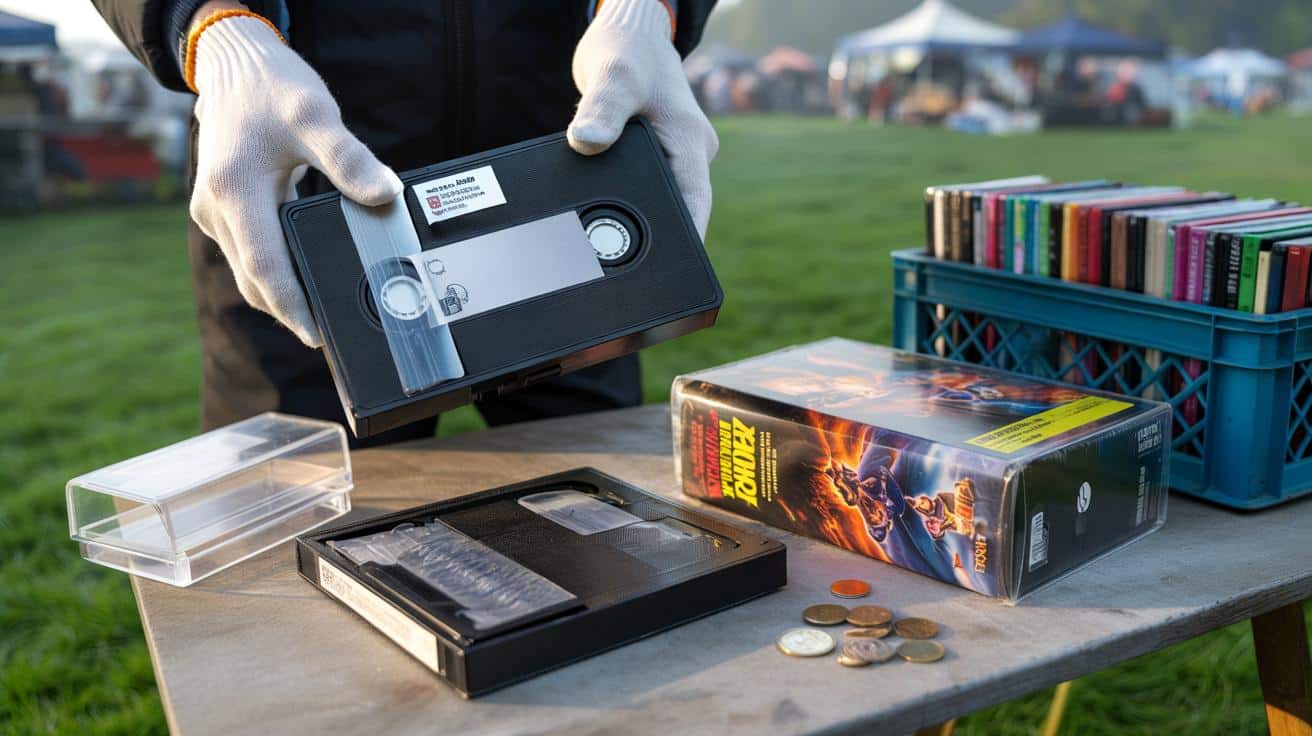
Across boot fairs, charity shops and online auctions, old VHS tapes are drawing real money — sometimes four figures, sometimes far more. The twist: collectors aren’t buying every tape. They’re chasing very specific stories trapped in plastic.
At a Sunday boot sale in Kent, I watched a man in a baseball cap hover over a milk crate of tapes like it was a jewellery case. He lifted each clamshell, checked spines, checked corners, Googled with a thumb that knew the drill. The stallholder, bored, named 50p a pop. The cap paused at a sun-faded horror with a retail sticker still stuck on. He smiled and paid in coins. The air smelled of wet grass and old plastic. He walked away fast. A few days later, that same tape popped up online for hundreds. One detail changed everything.
What’s actually worth thousands?
Collectors pay for story plus scarcity. The hottest VHS market is for **factory sealed** tapes — untouched, shrink-wrapped, with original studio seams and stickers intact. First retail releases of major films are the crown jewels. Early slasher and cult titles, big-box editions from the video shop era, and UK “pre-cert” tapes from before the 1984 Video Recordings Act all light up bidding wars. The reason is part nostalgia, part museum impulse. People want artefacts that freeze a moment: the first time Star Wars hit home video, the lurid oversize box of The Evil Dead sitting behind a counter.
Record numbers don’t live in anecdotes alone. In 2022, a sealed first-release Back to the Future reportedly sold at Heritage Auctions for tens of thousands, a headline number that sent casual sellers rummaging in lofts. Horror remains a powerhouse: early UK big-box titles from labels like VIPCO or Go Video can push into four figures if complete and clean. On eBay, real money hides in the “Sold items” filter, not the fantasy listings. You’ll see £400 for a pristine pre-cert Zombie Flesh Eaters, then £5 for the same title in a tatty later reissue. Same film, drastically different object.
Why the split? Value clusters where scarcity, condition and cultural heat overlap. A true **first print** might have a specific catalogue number, studio watermark on the shrink, or a distinctive logo variant used for only a few months. Seals matter because they de-risk condition and prove originality. Grading companies — CGC Home Video, VHSDNA and others — slab sealed tapes and add a score, creating a language investors understand. The market did get frothy, then cooled; prices are settling into a saner curve. Genuine rarities still climb. Routine tapes, even beloved ones, rarely do.
How to check your tapes like a pro
Start with the three-step scan: title, edition, condition. Look up the exact UPC or catalogue number on the spine or back. Search the title plus “first print” and compare art, logos and runtimes against collector sites and auction archives. If the wrap is present, study the seams — Y-folds on top or bottom, vertical seals, studio stickers — and watch for clouding or wavy plastic that hints at a reseal. No wrap? Then scrutinise corners, sun-fade, and rental stickers. Original price tags from long-gone chains can help, but gouges and rental punch holes slice value.
Let’s be honest: nobody does that every day. When you’re sifting a charity shop shelf, use shortcuts. Filter eBay by “Sold items” on your phone, not “Buy It Now” fantasies. Clock the hot zones: early horror, cult sci‑fi, action, music videos from small labels, and UK pre-cert tapes. Disney “Black Diamond” tapes? Most are pure hype, with thousands listed and few actually sold for more than a takeaway. Keep an eye on unique provenance too. A tape signed by a cast member or sourced directly from a filmmaker might carry a premium if the autograph and story check out.
One small habit can save hundreds: don’t “test” a potentially valuable tape. Tape-on-head friction can scrape a fragile leader or snap already brittle splices. If you think you’ve got something, bag it, document it, and do the research first. Prices rise where memory meets scarcity. If you’ve got both, you don’t need a VCR to prove it.
Preserve, price, and list without ruining value
Handle like a book you wouldn’t dog-ear. Store tapes upright on a cool, dark shelf, away from radiators and loft heat. Pop each into an acid-free sleeve or clamshell protector to stop scuffing. If a tape is still sealed, leave it sealed. Dust with a dry microfibre cloth only, no sprays. Photograph in daylight at a 45-degree angle to catch gloss and corners. Shoot the spine, front, back, top and any seams or stickers. Catalogue numbers and runtime shots help buyers verify at a glance.
Common pitfalls have simple fixes. Don’t peel rental stickers if they’ll tear the ink below; disclose them instead. Don’t rewind hard to the end and leave it there — tape packs compress; wind gently to the start if it’s not sealed. Avoid basements and garages where moisture warps sleeves and mould finds a home. We’ve all had that moment where a box smells musty and reminds us of a nan’s sideboard; that smell is trouble. Be candid in listings about odour, warping and any cracks. Buyers forgive small flaws when the description treats them like adults.
Collectors can be friendly guides, not gatekeepers. Many will help you identify variants if you show clear photos and ask plainly. Here’s how one described the hunt to me:
“I’m not buying a film, I’m buying a time capsule. First print, clean corners, the right sticker in the right place — that’s the rush,” said Liam, a Manchester-based VHS collector. “Horror or sci‑fi helps, but a neat copy of a mainstream classic can still sing if it’s the proper early run.”
- Quick check: early release date, studio logo variant, catalogue number matches known first-print data.
- Condition: tight shrink or crisp sleeve, square corners, no sun-fade strip along the spine.
- Provenance: ex-rental can be fine for big-box UK titles, but damage and drill holes cut value.
- Market: verify with Heritage Auctions archives, eBay Sold, and CGC/VHSDNA population reports.
The surprise joy — and the sober view
The power isn’t only in the payout. Listing a tape pulls you back to Friday nights under fluorescent light, choosing a cover by its art, not an algorithm. That’s why a glossy clamshell of The Thing can stop you mid-scroll; it’s a postcard from a world before skips and streams. Share that in your listing and you’ll reach the right buyer, the one who sees the same postcard. A thriving sale often starts with an honest sentence that sounds like a human remembered something real.
| Key point | Detail | Interest for the reader |
|---|---|---|
| Sealed first prints lead the market | Early retail runs with studio shrink and correct seams command premiums | Instant way to triage a box of tapes for high-value candidates |
| Genres and formats matter | Horror, cult sci‑fi, UK pre-cert, and **horror big-box** editions draw bidders | Focus your search on categories proven to sell |
| Research beats rumours | Check eBay Sold, auction archives, and grading pop reports before pricing | Avoid chasing myths like most “Black Diamond” Disney tales |
FAQ :
- Are my Disney “Black Diamond” VHS tapes worth thousands?In most cases, no. Many list high, very few sell high. Only unusual sealed early prints, misprints or celebrity-provenance copies reach notable prices.
- Should I open a sealed tape to test it?No. Opening vaporises collector value for sealed-first-print candidates. Photograph the seals and stickers instead, and reference sold comps.
- What grading services exist for VHS?CGC Home Video, VHSDNA and a small number of niche outfits grade and slab tapes. Grading helps on high-end items but isn’t necessary for modest sales.
- Do ex-rental tapes have value?Yes for certain big-box and pre-cert titles, especially horror, if complete and clean. Heavy wear, cut boxes and drill holes reduce prices sharply.
- How do I spot a first print?Compare catalogue numbers, studio logos, barcode styles, runtime and back-cover text to known first-release references. Small art and logo differences can be decisive.





Sealed BTTF in my attic — Y-fold seams. Real or re-seal?