
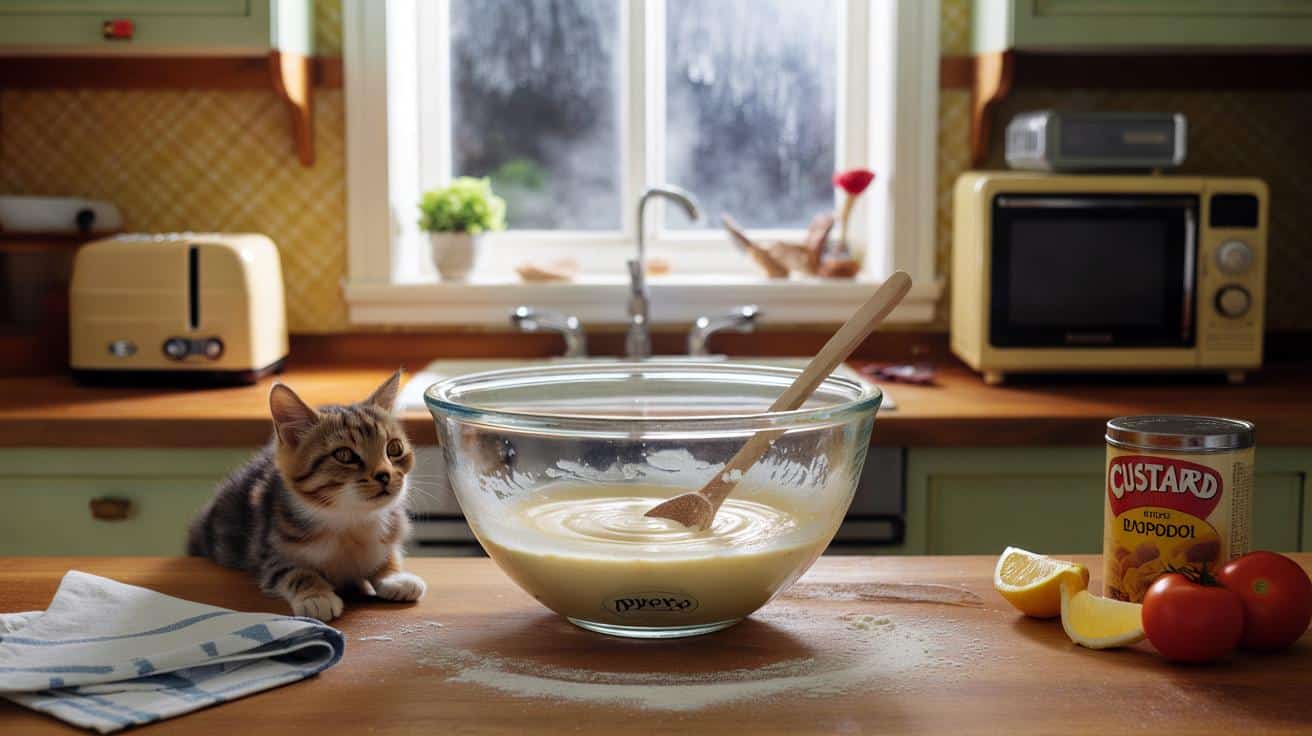
Big, clear, sturdy. The glass bowl that seemed to live on every 1980s worktop, next to the toaster and a tin of custard powder. Why did nearly every home have it, and why does just picturing it bring back the smell of sponge cake and wet woollen mittens on a radiator?
On a grey Saturday in 1986, a radio crackles out the Top 40 while steam fogs the kitchen window. Someone spills flour, someone else licks the wooden spoon, and the glass bowl sits in the centre of it all like a referee with infinite patience. It holds batter, then salad, then a rising ball of dough under a tea towel with a damp ring around the rim. The cat nose-taps the side as if to test its limits. You can see everything through it. You trust it. The bowl goes from mixing to microwave to table without fuss, catching light as it moves. It wasn’t fancy. It was there when it mattered.
It wasn’t there by accident.
The quiet superstar of the 80s kitchen
The glass bowl of the era — usually a Pyrex mixing bowl with a rolled rim — earned its spot through sheer usefulness. It didn’t clash with wallpaper or the brown-and-beige appliances. It looked clean, felt honest, and worked with whatever was cooking that night. You could whip cream in it, proof dough, set a jelly, or layer a trifle so pretty the neighbours went silent for a second.
I remember a Christmas on a cul-de-sac in Leeds: four houses, four bowls, four trifles resting on windowsills that misted over as the afternoon light fell away. One bowl stayed to marinate Boxing Day chicken, another went back home with a slice of cake wrapped in foil. We’ve all had that moment when you realise every family does the same tricks with the same kit. Flip through a mid‑80s Argos catalogue and you’ll spot it every few pages, hovering near casserole dishes and hand mixers like a calm, glassy moon.
There was logic under the nostalgia. Britain was learning microwaves, and see-through glass felt safer than guesswork with metal pans. Toughened glass didn’t react with tomatoes or lemon, so vinaigrettes tasted bright instead of metallic. Owning one bowl that could go fridge-to-oven-to-table suited tight budgets and tiny kitchens. **In a decade of make-do-and-mend sensibility, the transparent all-rounder beat out trendy plastics and fussy ceramic sets.** It was a design that respected time, not just style.
How to use and care for it like our mums did
Start with the weight. Hold the bowl low on your hip, keep the base anchored to a damp cloth, and whisk from the centre outward, letting the glass guide the curve of your wrist. For pancake batter: crack the eggs into the bowl first, beat them smooth, then sift in flour while pouring milk in a thin ribbon. **Stir from the centre out, not the other way round.** Let it rest under a tea towel for ten minutes. The bowl’s steady mass softens lumps without overworking the mix.
Don’t shock it. Cold bowl into a blazing-hot oven is how chips happen, and chips become cracks. Bring it to room temp, and if you’ve had it in the fridge, let it breathe on the counter while you pre-heat. Wash it warm, not scalding, and skip metal scouring pads. Cloudy film from hard water? A soak with warm water, a splash of white vinegar, then a dab of bicarbonate on a soft sponge. Let’s be honest: nobody actually does that every day. If you miss a week, the bowl won’t judge.
There’s a reason people still hunt these at car boot sales and charity shops. It carries the memory of meals that worked.
“My mum’s Pyrex outlived three toasters and a microwave. I still use it for Yorkshire pudding batter because it’s the only thing that never lies to me.”
- Thrifting checklist: run a finger round the rim for chips; check the base stamp (“PYREX” or “Arcopal/Arc International” on some European pieces); hold it to the light — good bowls look clear, not grey.
- Revive the shine: soak in warm water with a teaspoon of vinegar; gentle rub with bicarbonate; rinse and dry with a lint-free cloth.
- Smart storage: nest bowls with a square of paper towel between rims; keep them off the radiator or boiling hob.
More than a bowl, a lens on a decade
That glass bowl is a small truth about the 80s: form serving function, modestly and on repeat. It let you see the job as it happened — batter smoothing, cream peaking, sugar dissolving — so nothing felt mysterious or elite. Cooks watched, learned, adjusted. Recipes were clipped from newspapers, Delia taped on the VHS, and the bowl became the stage where ordinary hands pulled off small miracles. *It turned the kitchen into a place where you could try again tomorrow and it would be okay.*
Today, the same bowl fits a different mood. People crave tools that last, not gadgets that promise magic then hog a cupboard. TikTok thrifters hold up old Pyrex like trophies. Sustainability isn’t a lecture when it’s simply a habit, and a clear, tough, fixable bowl is a habit in object form. Pass one down and it becomes part of the family script. Share a snap of yours — trifle layers, bread dough, salad glistening — and you’re swapping more than tips. You’re swapping time.
| Key point | Detail | Interest for the reader |
|---|---|---|
| The bowl was everywhere because it did everything | Mixing, marinating, microwaving, serving — one tool for many jobs | Streamlines cooking, saves money and cupboard space |
| Design made confidence visible | Clear sides showed stages of cooking; toughened glass felt trustworthy | Helps avoid mistakes and learn by sight, not guesswork |
| It’s still worth buying second-hand | Look for chips, clear glass, a maker’s mark; easy to revive and store | Affordable, sustainable, and quietly stylish on the table |
FAQ :
- Which bowl are we talking about?The classic 1980s clear glass mixing bowl, most often Pyrex in the UK, with a rolled rim and a weighty feel. Some homes had similar bowls from Arc International or Anchor Hocking.
- Why did almost every home have one?It was affordable, widely sold in high-street chains and catalogues, worked with microwaves and ovens, and replaced multiple separate bowls and serving dishes.
- Is an old glass bowl safe to use?If it has no chips or cracks and you avoid thermal shock, yes. Retire any piece with rim chips or spidering lines, and warm it gradually before high heat.
- How can I spot a genuine vintage piece?Flip it: look for a clear maker’s stamp, consistent thickness, and a smooth, rolled rim. Many UK bowls read “PYREX” with a capacity mark moulded into the base.
- Can it go from fridge to oven?Not directly. Let it come to room temperature first, and don’t place it on a red‑hot hob or under a grill. That’s how thermal stress wins.




This unlocked a whole sensory memory—the fogged windows, the Top 40, and that Pyrex with the rolled rim refereeing our chaos. Ours did trifle at Christmas and Yorkshire pud batter on Sundays. I swear you could taste the trust. Off to the charity shop to hunt one down now 🙂