
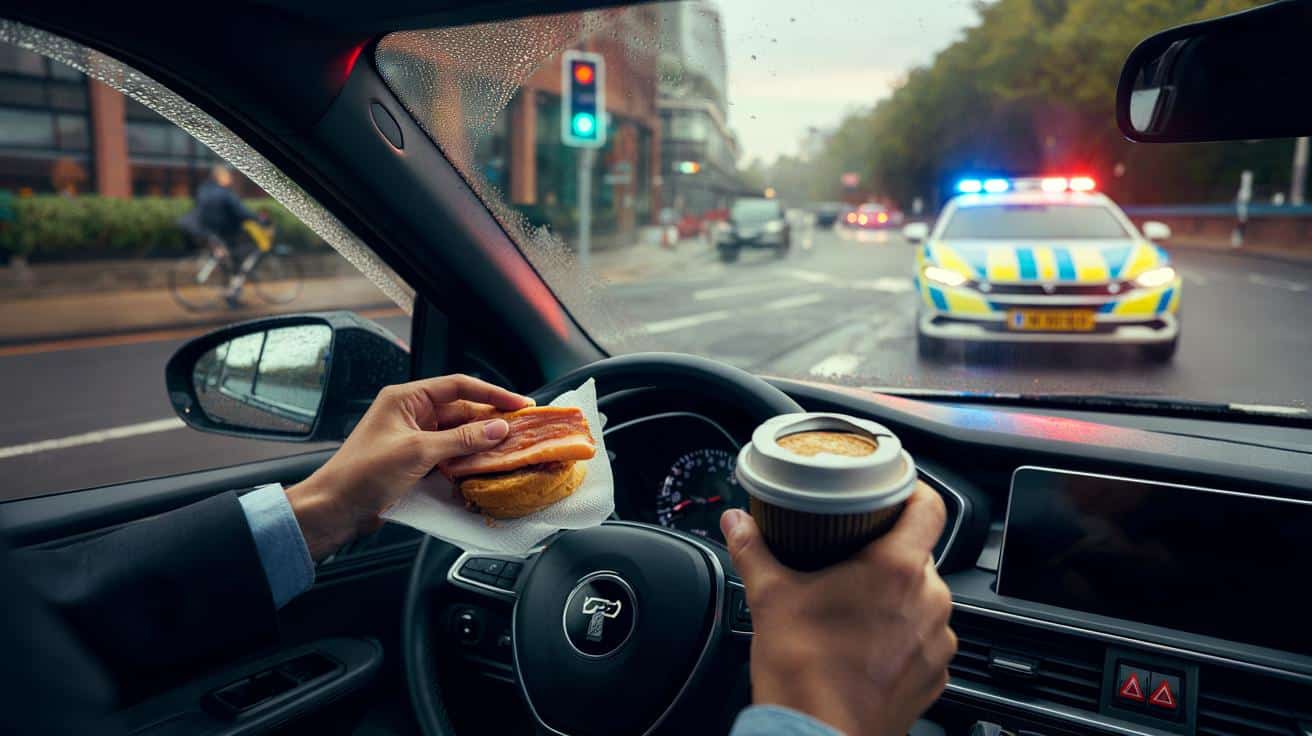
Harmless? Or a fast track to a fine and points on your licence. Here’s where UK law draws the line between a nibble and a legal headache.
The coffee lid hisses as you pull it off at the lights. Steam fogs the windscreen for a heartbeat, radio muttering travel updates you’re barely hearing. A bit of bacon slips, you dab at it with the napkin, eyes off the road just long enough to miss the green. Horn. You jump. The car creeps forward, you juggle the cup, and that tiny moment stretches into a riskier minute than you’d planned.
We’ve all had that moment when time is tight and the drive becomes the dining room. It feels normal, modern, almost efficient. Then you clock a police car in the mirror and wonder if your croissant just became contraband. The line isn’t where most people think it is.
What happens next depends on more than crumbs.
What UK law actually says about eating behind the wheel
There is no specific UK law that bans eating while driving. **No, it’s not outright illegal.** The catch is bigger: if food or drink distracts you, you can be hit with “driving without due care and attention” or “not in proper control of the vehicle.”
Police use discretion. If they see you wrestling a hot pasty and drifting across lanes, they can pull you over and issue a Fixed Penalty Notice. Typical outcomes include a £100 fine and 3 points. If the driving is poor enough to head to court, penalties can rise, with higher fines and more points on the table.
The Highway Code backs this approach. Rule 148 says to avoid distractions like eating and drinking, and while the Code isn’t law by itself, it’s used in court to judge whether your driving fell below a safe standard. *The test is simple: did your attention slip enough to put others at risk?*
Picture a driver biting into a wrap as a cyclist wobbles from a pothole. A smear of sauce hits the steering wheel, the driver dabs at it, and a parked car’s mirror takes the hit. No phones, no speed, just a split-second lapse. That minor collision is now on record as avoidable. The snack becomes evidence.
Plenty of officers share a similar story: coffee spill, knee on the wheel, a slow drift, and a sudden swerve. It doesn’t need to end in a crash to become a charge. A sharp brake that forces someone behind to react can be enough to trigger a stop and a stern conversation.
At the extreme end, eating while driving could feed into a dangerous driving charge if the behaviour is far below expected standards. Think steaming soup in your lap at 70mph, not a quick sip of water. That’s rare, but the law is built to catch the behaviour, not the menu.
How to eat on the move without inviting a fine
Plan your snack window like you plan your route. Use lay-bys, service stations, or a quiet side street for five minutes of calm. Open packaging before setting off, and choose one-handed, low-mess items if you absolutely must eat at the wheel. Keep water in a bottle you can lift without a second thought.
Go slow on tricky textures. Flaky pastries, dripping sauces, overstuffed wraps, and tubs that need two hands are booby traps in traffic. Let’s be honest: nobody does that every day. If you feel the urge to look down or find a napkin, that’s your cue to pull over. Your concentration is louder than your hunger.
Think about how it looks to the car behind you. A steady driver who takes a calm sip is one thing. A driver staring at their lap with sticky fingers is another.
“Safe driving needs concentration. Avoid distractions when driving or riding such as eating and drinking.” — Highway Code, Rule 148
- Open packaging before you move.
- Keep both hands free for busy junctions.
- Skip hot drinks in stop-start traffic.
- Use a short break for messy food.
- Clean spills only when parked.
The penalties, the premiums, and the bigger picture
Think of it like this: eating while driving is a legal grey that turns black the moment your control slips. **You can still be fined** if your snacking leads to poor lane discipline, sudden braking, or missed signals. A fixed penalty today can become a court date if the driving was clearly substandard.
Points don’t just sit on your licence. They sit on your insurance file. Insurers look at “careless driving” differently from a simple parking ticket, and premiums often rise after a conviction. **Insurance can spike**, not only from the points but from what they say about your risk profile.
Police aren’t chasing croissants. They’re watching for patterns: wandering wheels, late reactions, eyes dropping from the road. You can eat in a parked car as long as you’re not causing an obstruction or breaking local rules. That short pause might be the cheapest meal of the month.
Where the everyday meets the law
This is the reality of modern driving: long stretches, short breaks, and a dashboard that doubles as a table more often than we admit. The law doesn’t ban a sip or a bite. It asks a sharper question: were you fully in control when it mattered.
The safest habit is almost boring. Stop for five minutes, eat without stress, and start again calmer, cleaner, and sharper. Your future self will thank you when a child runs into the road or a van brakes hard without warning. One good pause beats one bad second.
Your commute isn’t a picnic, and your car isn’t a café. It’s a machine moving at weight and speed, near people you’ll never meet again. Respect that, and your snack stays just a snack.
| Key point | Detail | Interest for the reader |
|---|---|---|
| Eating isn’t banned | UK law has no blanket prohibition on eating while driving | You won’t be fined for the act alone |
| Control is everything | Fines and points apply if your driving standard drops | Know the real trigger for penalties |
| Costs ripple | Points for careless driving can raise insurance premiums | A quick bite can become an expensive habit |
FAQ :
- Can I legally drink water while driving in the UK?Yes, if you stay in full control. If that sip leads to poor driving, you can be penalised.
- What is the typical penalty for distracted eating?Often a £100 Fixed Penalty Notice and 3 points, with higher penalties possible in court.
- Does the Highway Code ban eating at the wheel?No. It advises against it and can be used in court to assess your driving standard.
- Could eating lead to a dangerous driving charge?Only in extreme cases where behaviour falls far below expected standards and risk is high.
- Is it safer to eat at traffic lights?Briefly, maybe. If the light changes and you’re still busy with food, you’re inviting trouble.

So the croissant isn’t illegal until it turns into a steering-wheel sauce incident? Good to know 🙂