
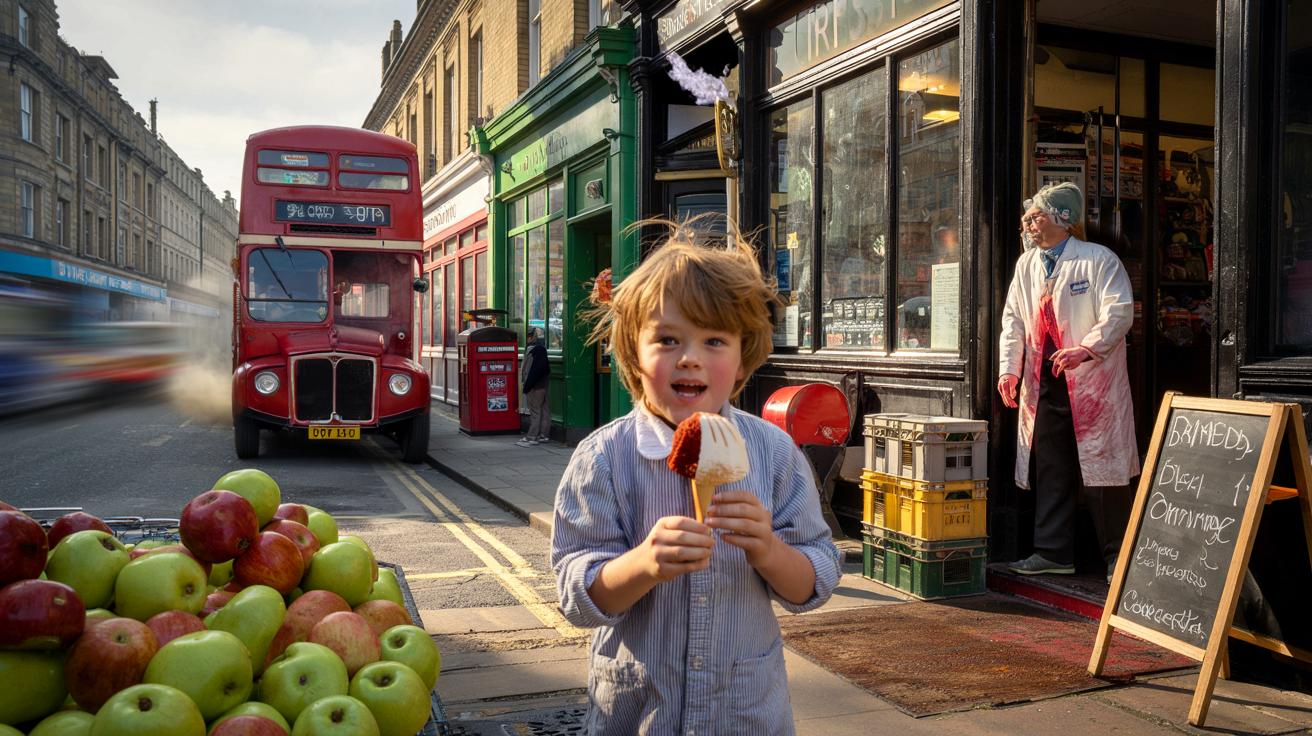
I found one at a misty car boot, tucked in a yellowing wallet, the print still faintly crisp. A double-decker in poppy red leans into a corner by a greengrocer spilling apples onto the pavement. A boy holds a 99 Flake with both hands, his sleeves too short for the April wind.
Shopfronts are hand-painted and slightly wonky. Cigarette smoke threads out of a café door where steam fogs the windows. It smells of petrol and warm bread. A woman laughs without looking up as she digs for coins, and a bus conductor stamps time like a drummer.
Stand there long enough and the picture begins to hum. Shadows are thicker. Prices are lighter. The world looks slower, and somehow louder. The past blinks back.
High streets before the algorithm
In those photos, Britain’s high streets look like living rooms that spilled outside. Butchers’ hooks, tins stacked like pyramids, chalkboards with wonky “4p each” scribbles from the first years of decimal money. You can almost hear newspaper vendors singing the headlines and the clatter of milk crates skidding off a barrow.
Everything is a little scuffed, a little human, and incredibly alive. Shopkeepers stand in doorways, arms folded, claiming a patch of pavement like it’s a family heirloom. No glossy branding, little plastic sheen — just names painted by people who knew the owner’s voice.
A print from Birmingham shows a pram wedged between shoppers while a coal lorry noses past, dust rising on a dry Saturday. Another from Salford captures a butcher grinning, white coat streaked with crimson, as a bus flashes a route number that hasn’t run in decades. In the window: “Apples 12p — New Season”. Decimalisation was still fresh, and you feel the country counting again with new fingers.
There’s a hazy winter frame of candles in a terraced kitchen, kettle on a gas hob, the Three-Day Week still in people’s bones. And, yes, there’s heat: a washed-out shot of kids in 1976, feet blackened, paddling in a fountain that wasn’t meant for paddling. The camera doesn’t judge. It just keeps time.
Look closer and the logic of a pre-digital street appears. Fewer cars, more walking, smaller radiuses of life. Kids roam in packs because the world is smaller, and the risk feels differently measured. Ads are local, not targeted; gossip is the algorithm. Seatbelts aren’t yet a habit. Smoking is allowed almost anywhere, and nobody blinks.
These photos show not a better Britain, but a Britain arranged around proximity — your butcher knew your cough, your newsagent knew your football mood. Scarcity tuned people to each other. When the lights flickered, neighbours arrived with candles without asking why.
Reading the 1970s through photos: a simple method
There’s a trick to reading these images so they talk back. Start with the corners, not the faces. Bus numbers, shop signs, price boards, dustbins — they’re time-stamps hiding in plain sight. Note the typography, the coin in someone’s hand, the colour of the phone box.
Then triangulate. Cross-check the route number with old timetables online, or match a roofline on Street View with a 1970s skyline in the shot. Ask older relatives what “Fletchers” sold on your high street. You’ll be surprised how one memory unlocks several more, like keys on a ring you thought you’d lost.
Common mistakes? Romanticising the grit, or assuming the greyness meant joyless lives. Misdating by fashion alone. Cropping out context because the face is so good. We’ve all done it. **Let’s be honest: nobody really does this detective work every day.** But when you do, the image gains a spine.
Avoid overreading small details, too. A pram doesn’t always mean poverty; a suit doesn’t always mean wealth. Try to balance feeling with evidence. Ask: what else could be true here? That small question keeps the picture honest, and your story kinder.
One archivist told me:
“Treat the photo like a room you’re walking into. Say hello. Notice the smell. Then look at the light.”
It sounds whimsical, yet it helps you resist quick takes and find the slow facts. Here’s a quick pocket guide to keep in mind:
- Scan for signs, numbers, and prices before faces.
- Cross-check with maps, bus routes, and local papers.
- Collect memories, not just pixels — ask someone who was there.
What the rare photos quietly say about change
When you lay these pictures next to our lives now, the scale of change isn’t just technical — it’s social muscle. The 1970s carry more public-ness: kids in streets, parents on doorsteps, the high street as stage. Today we’re tidier, faster, safer in many ways, and yet more private, more individually buffered.
The gains are real — cleaner air, better safety, longer lives, richer choices — and the losses are subtle, like a faint hum you only notice when it stops. Fewer spontaneous chats at the shop counter. Fewer chances to be lightly known by strangers. The pictures don’t argue. They invite.
We’ve all had that moment where an old photo punches through the day and you suddenly miss a place you never lived in. That ache is useful. It asks whether we can borrow the best bits — the neighbourly routines, the shared errands, the pride in small places — and smuggle them into the now.
Stare long enough, and the 1970s don’t feel far away at all. They feel like an option. Not a costume to wear, but a set of habits we could remix. **Maybe that’s the quiet power of these rare images — they don’t just show us then; they hand us a way to be together now.**
| Key point | Detail | Interest for the reader |
|---|---|---|
| High streets as social rooms | Hand-painted signs, local traders, slower rhythms | Helps decode what we’ve lost or might revive |
| How to “read” a vintage photo | Start with corners, cross-check routes, collect memories | Practical method to make old images speak |
| Change without nostalgia | Safer, cleaner present meets thinner public life | Balanced lens to think about community today |
FAQ :
- Where can I find rare 1970s photos of Britain?Start with local archives and libraries, Flickr Commons, regional newspapers’ photo desks, and community Facebook groups. Auction sites and charity shops often hide unlabeled gems.
- How can I date an old street photo accurately?Combine bus route numbers, shop names, and price boards with old timetables, directories, and map overlays. Clothing helps, but it’s the least reliable on its own.
- Why do the colours look different to modern images?Film stock varied — Kodachrome ages well, Ektachrome can shift. Lab chemistry, storage, and scanning all influence the tone you’re seeing now.
- What has changed most since the 1970s?Everyday risk and proximity. More regulation and safety, less casual public mingling. Homes are more comfortable; streets feel less shared.
- How should I preserve family prints from that era?Keep them cool, dry, and out of direct light. Use acid-free sleeves, scan at high resolution, and record names, dates, and places while someone still remembers.



Your descriptions smell like petrol and warm bread—I could almost hear the bus conductor and the milk crates. Loved the idea that gossip was the algorithm, and the tip to start reading a photo from the corners. It made me look at my nan’s Birmingham snapshots diferently: bus numbers, chalkboards, even the coin in her hand. Funny how scarcity tuned people to each other without turning it into pure nostalgia. This piece hums, like you said.