
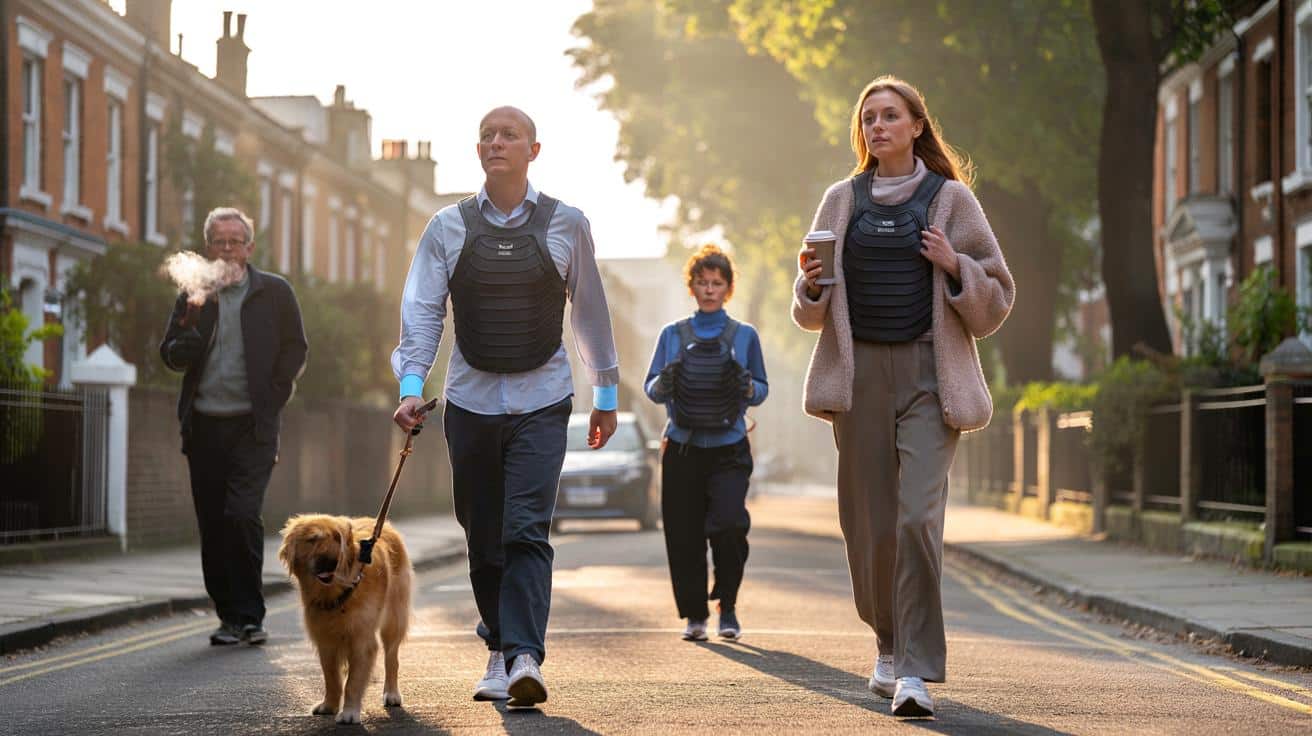
Not runners, not gym-goers on the move, just ordinary walkers who’ve added a layer that looks like tactical gear and feels like intention. Weighted vests are suddenly everywhere on the morning walk, from the park to the school run. What changed isn’t the route or the coffee after. It’s the load, and the way it makes a gentle habit feel purposeful. Are people chasing speed, calories, stronger bones—or simply a sense of momentum?
It’s 7:18am on a side street in Stoke Newington and everyone moves like they’ve made a pact with the day. A man with a golden retriever strides past with a weight vest hugging his ribs, each footfall a deliberate tap. A woman in office trousers carries a takeaway flat white and a small vest that’s almost hidden under a fleece, her shoulders set like she means it. The city wakes like a cat stretching, slow and precise. These vests don’t beep or glow. They don’t shout your effort to the world. They change the feel of the walk. It looks calm. It isn’t.
The quiet upgrade to a daily ritual
The appeal is sneaky: you keep the walk, add a little gravity. The vest acts like a dimmer switch for effort, nudging your heart rate without asking you to sprint or smash out intervals. That’s the magic for time-poor people who want more from the same thirty minutes. You still get the fresh air, the voice note to a friend, the dog sniffing every lamppost. Only now, your body has to wake up too. The ritual doesn’t change. The intensity slips in.
A small tweak goes a long way. Research on loaded walking suggests that adding roughly 10% of your bodyweight can raise energy cost by something like 5–15%, depending on pace and hills. You feel it on stairs, in the glutes, in the way your arms want to swing a touch wider. I watched a commuter this week take a long breath at the top of the footbridge, not wrecked, just present. She didn’t speed up. She got stronger by standing still for three seconds and then carrying on.
Beyond calories, there’s a structural story. Load tells your bones and connective tissue that life doesn’t only happen in chairs, and that signal—little, repeatable stress—seems to help. Vests distribute mass across the torso rather than dragging your shoulders like a heavy tote, so posture can improve when the fit is right. For walkers who don’t want to pound their knees with running mileage, the vest slots between everyday movement and gym work. It feels adult: pragmatic, boring in a good way, quietly effective.
How to wear one, actually
Start lighter than you think, then let your body write the script. A simple rule: 5–10% of your bodyweight for beginners, 15% for the seasoned, and short routes at first—20 to 30 minutes—before you extend. Fit it high and snug so the load doesn’t bounce, with most of the weight on your torso rather than hanging at the front. Walk tall, soften the ribs, breathe through the nose for a few minutes, then ease into your normal rhythm. **Go lighter than your ego.** The goal is quiet effort, not a hero story.
Common missteps are exactly what you’d expect. Going too heavy, too soon slices your posture and steals the joy from the habit. Sloppy straps rub; soft shoes and slouching hips make the back complain. We’ve all had that moment when a good habit turns into homework, so be kind to the future you and keep the route familiar until your body adapts. Let’s be honest: nobody really does this every day. Two or three walks a week is a sweet spot for most people, with at least a day off between loaded sessions.
Think cues, not punishments. One or two rules you can remember at a crossing will carry you further than a perfect plan you forget by Thursday.
“Add weight, add attention. That’s the whole trick.”
- Start with 5–10% bodyweight; bump by small steps when the walk feels “too easy.”
- Keep the vest high and close; no flapping panels, no front-loaded slump.
- Walk tall: crown of head up, ribs stacked, short quick steps on hills.
- Choose flat routes first; save trails and stairs for when your form stays crisp.
- End one minute early while you still feel good—momentum matters tomorrow.
Why this tiny load feels bigger than it looks
The vest works on the mind as much as the muscles. It creates a boundary around your walk, a signal that this slice of morning is not for emails or scrolling, but for being a body that moves through air. That tiny inconvenience—the time to strap in, the slight squeeze around the chest—adds friction in the best way, and the payoff is a small sense of pride before 8am. Share a lap with a friend, swap vests for one hill, compare notes on how it changes your focus. **Progress beats punishment.** What you’re really carrying is a promise to keep showing up.
| Key point | Detail | Interest for the reader |
|---|---|---|
| Start light | Begin at 5–10% of bodyweight, 20–30 minutes, flat route | Feels doable today, safer on joints, builds early wins |
| Fit matters | High, snug vest with balanced plates; no bouncing or slouching | Better posture, fewer rubs, more comfortable miles |
| Train the habit | Two to three loaded walks a week with rest days | Steady progress without burnout, fits real life |
FAQ :
- How heavy should a weighted vest be for walking?Start with 5–10% of your bodyweight and see how your posture and breath respond. Add small increments only when the walk feels conversational.
- Is it safe for my knees and back?For most healthy walkers, a light, well-fitted vest is joint-friendly. If you have pain or a recent injury, speak to a clinician before loading up.
- Vest or backpack—what’s better?A vest spreads weight across the torso, which helps posture and balance. Backpacks pull backward and down; fine for errands, less ideal for steady form.
- How often should I wear it?Two or three sessions a week works for many people. Keep at least one day between loaded walks to let tissues adapt.
- Can it help with bone density or weight loss?Light, regular loading is used in some programmes to support bone health, and extra effort can aid energy balance. Results come from consistency and recovery.







Loved this—quiet effort over hero stories. Bookmarked.