
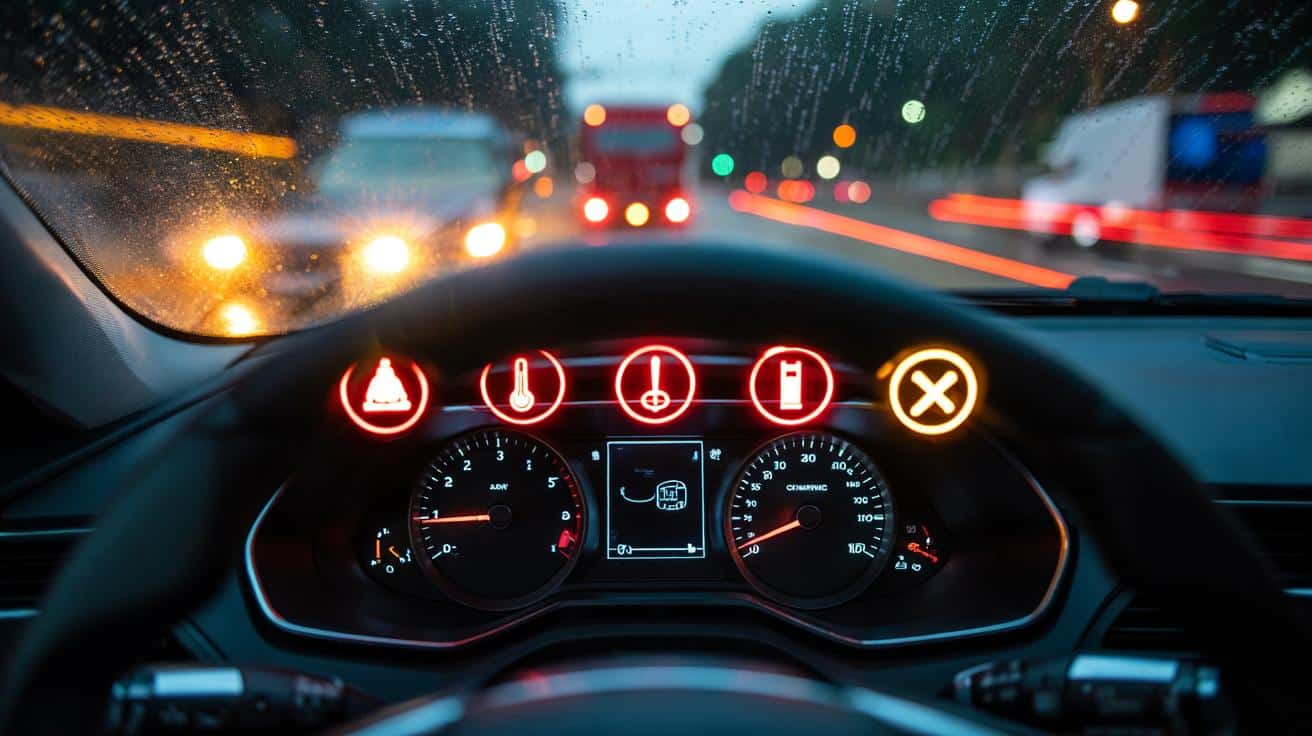
They arrive without warning, glow in accusing red or stern amber, and then vanish when you don’t look. Ignore them once, and you might get away with it. Twice is a gamble.
Rain needles the windscreen and the radio fizzles between traffic updates and a phone call you let ring out. A red icon blinks into life on the dash — a little oil can, almost cute, except your stomach drops like a lift. You lift your foot, feel the car’s pulse change, scan for a lay-by as lorries throw spray across your mirrors. That small light feels like a message from the future, one you don’t want to read. That tiny symbol is the car’s way of shouting. You breathe, indicate, and pull over. There’s a truth about warning lights people only learn once.
The five dashboard lights you should never, ever ignore
Some icons are gentle nudges. These five are not. The oil pressure light (that dinky oil can) means your engine may be running dry — metal kissing metal. The red temperature light or thermometer symbol signals an overheating engine. The brake warning light — a red circle with an exclamation mark or ‘BRAKE’ — hints at low fluid or a system fault. The battery/charging light (a little battery) means the alternator might not be feeding the car’s electrical life. And a flashing check-engine light? That’s misfire territory, raw fuel hitting the catalytic converter.
Mia, a nurse heading for a night shift, watched a red thermometer flicker in stop-start traffic and thought she’d push on to the next junction. Steam arrived first. A patrol eventually coaxed her car onto a recovery truck and, days later, a mechanic politely explained the phrase “warped head” with a quote that sounded like a holiday disappearing. Conversely, I’ve seen a battery light save a mate’s bacon: he killed the stereo, dimmed the lights, and glided into a services just before the whole car died. Two choices; two outcomes.
Here’s why these five matter more than the rest. Oil pressure buys you the thin film that keeps pistons from seizing; its loss is minutes, not hours. Temperature spikes can cook gaskets and warp heads, and opening the bonnet won’t cool a thing if coolant isn’t circulating. A brake warning light can mean fluid loss or worn pads — either way, stopping distance grows just as a child steps off a kerb. A charging fault drains your battery like a slow leak; once voltage tumbles, steering, lights, and engine management begin to misbehave. And a flashing MIL? That’s your engine misfiring so badly it can melt the catalyst: a flashing check-engine light is an emergency.
When a warning light pops up: your calm, clear plan
Stay smooth. Easing off the throttle buys you options. Scan for a safe place — a lay-by, services, or the next exit — and signal early. If it’s oil pressure or the red temperature light, pull over and switch off promptly; you’re protecting the engine by not turning it into a metal lathe. For a brake light, gently test the pedal once: if it’s spongy or travels further than usual, keep speeds low and stop somewhere safe. With a battery light, trim power use — blower off, heated screens off — and aim for a safe stop before the lights dim. For a flashing MIL, reduce revs, avoid heavy load, and pull over.
On the shoulder or in a car park, hazard lights on, handbrake applied, and stand behind the barrier if you’re on a motorway. Don’t pop the bonnet if there’s steam; wait. Check the owner’s manual for icon nuances — some cars display separate coolant level and temperature warnings. If you can, peek under the car: drips of oil or fluid tell a story. A small toolkit, torch, gloves, and a litre of the correct oil live happily in the boot. Let the car cool before any checks. Don’t open a hot radiator cap.
We’ve all lived that little prickle of dread when a light appears, the negotiation you start with yourself — “Maybe it’ll go away.” It might. Many don’t. Common mistakes are carrying on because the car still feels fine, clearing a fault code with a bargain OBD dongle, or topping coolant with whatever’s to hand. Low oil? People often overfill and cause a fresh problem. Brake light? Some jab the pedal to “test” it hard and get a nasty surprise. Let’s be honest: nobody checks fluid levels weekly. You don’t need to be perfect. You need to respond like the light means what it says.
“A red light isn’t a suggestion,” a Birmingham technician told me. “It’s your last polite warning.”
- Oil pressure light: ease off, pull over, switch off, call for help.
- Red temperature light: heater to hot, fan on, pull over, engine off after stopping.
- Brake warning light: gentle pedal test, stop safely, don’t continue if it feels odd.
- Battery/charging light: reduce electrical load, head for a safe stop or garage.
- Flashing check-engine light: reduce revs, pull over, recovery rather than limping home.
Read the room, not just the light
Cars talk in context. A red oil can at idle after a long motorway run suggests thin oil and low pressure; the same light after hitting a speed bump could be a damaged sump. A brake warning after a fresh pad change might be a sensor or fluid level just under the mark; after a long descent, it can mean heat fade. A battery light after a splash through deep puddles might clear — belts squeal and dry — while a steady glow on a dark evening usually ends with dim headlamps and a quiet engine. What matters is your response: choose the safe place, take the beat, phone a friend, call your breakdown service. A dash light is a prompt to act like the grown-up at the wheel. Red means stop. Amber means plan. Sharing that wisdom with the next driver in your life might be the difference between a nudge and a nightmare.
| Key point | Detail | Interest for the reader |
|---|---|---|
| Oil pressure light | Loss of lubrication can seize an engine in minutes; stop and switch off immediately. | Saves thousands and avoids catastrophic failure far from home. |
| Battery/charging light | Alternator not charging; you’re running on borrowed volts until the car dies. | Time your safe stop, trim load, and avoid being stranded in a live lane. |
| Flashing check-engine light | Active misfire can destroy the catalytic converter quickly. | Prevents big repair bills and keeps emissions hardware intact. |
FAQ :
- Can I drive with the battery light on?Shortly and gently to a safe stop or garage, yes — but expect the car to die as voltage drops. Trim electrical load and don’t linger.
- Is a solid check-engine light urgent?It needs attention soon, but it’s not the same as a flashing light. Book diagnostics; avoid hard driving until you know the cause.
- What if the brake light flickers on hills?Fluid may be low and sloshing. Top up with the correct brake fluid and have the system inspected for leaks or worn pads.
- Why does the oil light come on at idle?Thin or low oil, a tired pump, or a bad sensor. Check level first on level ground; if the light persists, get it checked.
- What should I keep in the car for warning-light moments?A torch, gloves, reflective vest, correct oil, screenwash, phone charger, and your breakdown number. Simple kit, big calm.







Definately needed this. I ignored that little oil can once and the engine started ticking like mad—pulled over just in time. Lesson: red means stop, not “one more mile”.
So a flashing MIL is basically the car screaming in Morse, right? 😅