
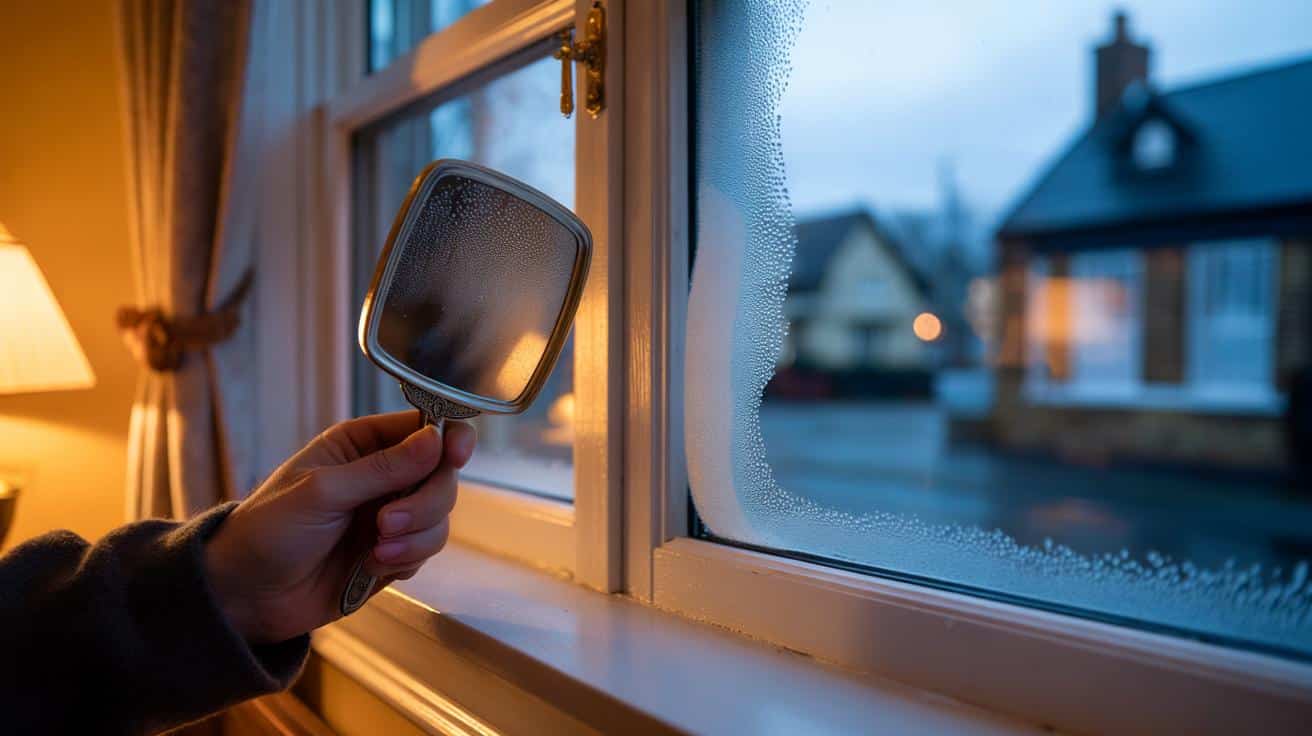
Rising bills, chilly corners, and that nagging sense your beautiful windows are betraying you. Here’s a quick, oddly satisfying way to find out if heat is slipping away — with nothing more than a small mirror and a minute of quiet attention.
You put your palm near the sash and feel it: a faint shiver of cold where the frame meets the pane. The room isn’t freezing, yet the warmth seems to thin near the window, like breath fading in the air.
I learned the trick from a neighbour who carried a scuffed pocket mirror in his coat like a talisman. He chilled it against his tea mug, stepped to the bay window, and moved the mirror along the seals the way a doctor reads a pulse. In places it fogged and stayed fogged; in others it cleared instantly.
He didn’t say much. He just watched the mist. Then the mirror told me a secret.
Why a tiny mirror beats guesswork
You can feel a draught with your hand, true, but hands get fooled. The boundary of cool and warm air is thin and twitchy, and your skin adapts faster than you think. A chilled mirror doesn’t adapt. It reacts, and it does it visibly, turning invisible airflow into a little theatre of mist and clarity.
We’ve all had that moment when the room is warm but the sofa by the window feels like seat 13A next to the plane door. In older British homes, windows contribute a big chunk of heat loss — typically around 10–20% of the total, depending on the glazing and gaps. On my street in Leeds, two nearly identical terraces told different stories: one with tight new seals, one with tired putty and a wobble in the latch. The first sat steady at 19°C on the thermostat with modest gas use; the second ran hotter yet felt colder by the window.
Here’s the logic. A cold mirror gathers condensation when warm, humid room air touches it. If warm air is rushing out through a gap, it will often clear the fog near that gap faster, because the moving air is mixing and warming that spot. If icy outside air is slipping in, the cold flow can make fog linger or reappear along the path of the draught. The mirror becomes a tiny weather map, showing where air is moving and in which mood.
The mirror trick: step by step
Grab a small mirror — a compact or a shaving mirror is perfect. Pop it in the fridge for 5–10 minutes, or against a bag of frozen peas for a couple of minutes if you’re impatient. Close doors in the room, let the heating run as usual, and wait a minute for the air to settle. Now hold the mirror 1–2 cm from the window frame and seals, moving slowly along the edges, corners, and any joinery you suspect. Breathe lightly toward the mirror to fog it, then watch what the mist does near each junction. Slow, even clearing suggests calm air. Sudden clearing, streaks, or persistent fog lines tell a different tale.
Start low along the sill where outside air loves to sneak in, then run up the jambs and across the head. Pause at trickle vents, meeting rails, and around any locks or hinges. Try the mid-pane too — glass can be sound but the spacer bar or bead can misbehave. Use a torch at night to catch the fog edges. And if you have curtains or blinds, test with them open and then half-closed to see how fabric shapes the airflow. Let’s be honest: nobody really does that every day.
Small mistakes can blur the signal. Keep your hands off the mirror face so your skin heat doesn’t warm it, and don’t test just after a shower or a big boiling pasta session — the humidity spike will make everything foggy and dramatic, even when it’s not. Run the test when the outside is meaningfully colder than inside for a sharper contrast. **Repeat the pass** once or twice so you know you’re seeing a pattern, not a one-off swirl.
“You can learn more in two slow minutes with a chilled mirror than in twenty minutes waving incense around,” says Amy Collins, an energy assessor who audits Victorian semis for a living. “It reveals both leaks and the way your room breathes.”
- Fog that clears fast at one point: warm air likely rushing out through a gap.
- Fog that clings or thickens in a thin line: cold air slipping in along that path.
- Fog uniform across the pane: stable air; heat loss might be through the glass spec, not a gap.
- Fog near the bead or spacer: consider deterioration of seals or thermal bridging.
- No real change anywhere: your window may be tight; test doors next.
Carry a notebook or snap photos as you go. You’re building a **draught map** of your home.
What the mirror tells you next
Once you’ve marked the hot spots, tiny fixes can bring quick wins. A hairline gap along the meeting rail often responds to a sliver of self-adhesive draught strip. A tired bead might need a length of silicone sealant and a calm hand. Trickle vents can be adjusted, not ignored; they’re there for air quality, but they shouldn’t whistle. If you spot fog lingering at the bottom rail, look outside too — clogged weep holes or crumbling putty can draw cold air like a straw.
Double-glazed but still chilly? The mirror might be telling you the glass spec is basic, or a unit has failed. If the unit is misting inside the cavity, no trick will fix that but a replacement. Single-glazed sashes can be surprisingly cosy with good draught-proofing and heavy curtains. Don’t forget the human side either: a dog flap or that never-closed laundry vent can undo all your careful work. And if your mirror keeps pointing to a rotten frame, **call a professional** who knows the specific quirks of timber or uPVC around you.
There’s a side benefit few mention. A mirror session teaches you how your home breathes — where air enters, where it leaves, where it pools behind furniture. Move a sofa off a cold wall and you may see the fog pattern soften next time. *A little choreography with your furniture and fabric can feel like new insulation for the price of nothing.* On a bright weekend, share the trick with a neighbour, compare notes, and trade five minutes on each other’s casements. Curiosity warms a street faster than gossip.
| Key point | Detail | Interest for the reader |
|---|---|---|
| Use a chilled mirror | Fog and clearing patterns reveal air leaks at frames, beads, and vents | Turns invisible draughts into visible cues you can act on |
| Read the patterns | Fast clearing suggests warm air escaping; persistent fog hints at cold ingress | Helps you target fixes that actually change comfort |
| Fix small, feel big | Draught strips, sealant, vent tweaks, smarter curtains | Low-cost changes can reduce bills and warm up cold spots |
FAQ :
- Does this work on both single and double glazing?Yes. You’re reading air movement around the frame and seals, not just the glass. The mirror won’t diagnose glass coatings, but it will spot draught paths on any window type.
- What’s the best time to test?A cold, still evening when the heating is on and the outside air is at least 6–8°C cooler than inside. Calm air gives the clearest fog patterns.
- What if I don’t have a mirror?Use your phone screen cooled for a minute against a cold can, or a stainless-steel spoon. The key is a cool, non-porous surface that shows condensation and clearing.
- How reliable is the mirror trick versus a thermal camera?Thermal cameras show temperature differences on surfaces, which is brilliant for insulation issues. The mirror highlights airflow, which is just as crucial. Together, they’re gold.
- What fixes should I try first if I find leaks?Start with self-adhesive draught strips, silicone around beads, latch adjustments, and checking trickle vents and weep holes. If a unit has failed, plan for replacement rather than patching.







Brilliant explainer! I just did the fridge-mirror test and could literally watch the fog streak along one corner bead—never noticed it before. The step-by-step was clear, esp. the reminder to avoid testing after a steamy pasta session. Going to try a thin draught strip and a dab of silicone where the fog lingered. This is such a simple, oddly satisfying trick; feels almost like having a tiny weather station in my hand. Definately bookmarking.