
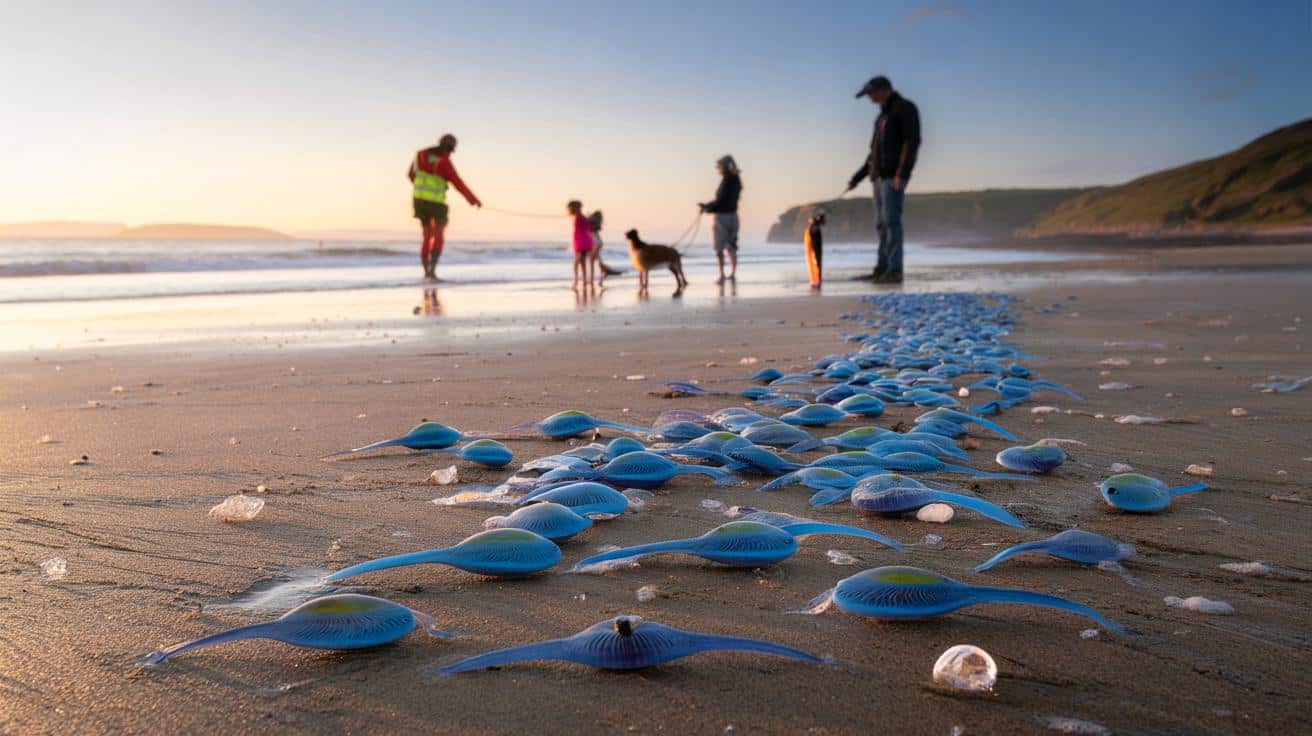
Then the morning light rose and an entire tide of blue came into view — thousands of tiny discs, rimmed in sapphire, strewn along Cornwall’s sand from Newquay to Sennen. Parents pulled children back. Dog walkers hesitated mid‑stride. The sea had brought something beautiful and a little unsettling, and left it at our feet.
At Perranporth just after sunrise, the surf sounded tired, as if it had dragged half the ocean ashore in the night. The strandline shimmered with coin‑sized bodies, each one a translucent oval with a dark, cobalt underside and a small, tilted sail. A gull pecked, thought better of it, and hopped on. A boy in a wetsuit reached down. His mum said, “Leave them be.” A lifeguard walked past, scanning faces more than waves. The beach felt different, like a rumour had arrived on the tide. Something was happening, quietly.
When the sea turns cobalt
This isn’t the first time Cornwall has woken to a blue tide. Local groups have logged similar strandings in recent springs, often after days of onshore winds and calm, lingering swell. The creatures are most likely by‑the‑wind sailors — Velella velella — not true jellyfish but close cousins that drift the open ocean on tiny transparent sails. Seen from above, they’re delicate. Underfoot, they can be startling. **These creatures are striking, but they’re not toys.**
On Gwithian Towans, a kite flier stopped counting after a hundred. He pointed to a patch the size of a coffee table, full of them, layered like stained glass. A local surfer said he’d seen the same back in 2014, “then again a few summers later, big winds from the west.” Social feeds filled with photos: palms cupping sky‑blue medallions; beaches ribboned with electric colour; kids asking if they were aliens. We’ve all had that moment when the sea delivers something we can’t quite name and our brain flips between wonder and worry.
What we’re seeing fits a known pattern. Velella travel in vast rafts across temperate oceans, their angled sails acting like tiny wind vanes. A run of south‑westerlies pushes them landward; spring plankton gives them food; a clear night and a soft tide finish the job. Blue jellyfish (Cyanea lamarckii) also visit UK waters and can strand in numbers, but they carry a domed bell and trailing frills, not a neat sail. Portuguese man o’ war, meanwhile, are a different beast entirely — a floating colony with a purple‑blue bladder — rarer in bulk and far more painful to encounter.
What to do on the sand
Start with space. Give them a berth and steer curious fingers away. If you need to move one, use a stick or wear gloves; even beached Velella can irritate sensitive skin. Walk around big clusters rather than through them — not just for you, but for seabirds and scavengers who’ll feed as the tide recedes. If a strandline is thick with blue, choose firmer sand closer to the waterline where the wash has cleared a path.
With dogs, keep leads short near the wrack. Licking or mouthing can cause drooling and mild distress; call your vet if that happens. For swimmers and paddleboarders, scan the surface before wading in. Where the wind stacks them, the concentration can spike near headlands and harbour mouths. Let’s be honest: nobody really memorises tide, wind and jelly reports every day. A quick look at local surf cams or beach groups on your phone will tell you more than a long scroll through warnings.
If you do get a mild sting, rinse the area with seawater, not fresh, and carefully lift off any clinging bits with tweezers or the edge of a card. Immerse the area in warm water — as hot as you can comfortably tolerate — for 20 minutes to ease pain. **Hot water, not freshwater, helps neutralise most UK jellyfish stings.** If symptoms escalate — breathing issues, spreading rash, or a reaction in the eyes — seek medical help promptly.
“The sea sets the agenda, not us. Days like this are a reminder we swim in a living soup — fascinating, sometimes prickly, always in motion.”
- Hands off: admire, don’t handle — especially with kids.
- Footwear helps: thin soles protect on algae‑slicked rocks and from stray tentacles.
- Keep dogs close: avoid sniffs and licks; call a vet if they react.
- Photograph for ID: sail equals Velella; bell and frills suggest a true jellyfish.
- Check local updates: lifeguards and beach groups share real‑time conditions.
Why it’s happening — and what it tells us
There’s a bigger story behind the blue. Marine scientists point to a mix of wind patterns, seasonal blooms and shifting sea temperatures nudging these drifters ashore. Some years the rafts pass unseen, just a thin ribbon out beyond the break. Other years — when winds hold and plankton booms — they arrive en masse, then vanish as quietly as they came. **Most strandings are natural events, not pollution incidents.** It’s a pulse of ocean life crossing the tideline, a visible sign that the food web is humming. And yes, that’s a little unsettling and a little thrilling.
| Key point | Detail | Interest for the reader |
|---|---|---|
| What washed up? | Mostly by‑the‑wind sailors (Velella), sometimes blue jellyfish. | Helps you recognise what you’re seeing and gauge risk. |
| Why now? | Onshore winds plus spring plankton blooms and seasonal cycles. | Explains the sudden arrival and sets expectations. |
| What to do? | Keep distance, protect pets, treat stings with seawater rinse and heat. | Practical steps for a safe, still‑beautiful beach day. |
FAQ :
- Are these “blue jellyfish” dangerous?Velella typically cause only mild irritation. True blue jellyfish can sting more noticeably, but they’re rarely serious. If symptoms worsen, seek medical advice.
- How do I tell Velella from other species?Look for the sail: a small, angled, transparent fin on a flat oval. No trailing tentacles. A domed bell with frilly arms points to a true jellyfish.
- Should councils remove them?Often they’re left to break down naturally and wash away on the next tides. Large accumulations near busy access points may be cleared case‑by‑case.
- Can they still sting when dead?Yes, to a degree. Nematocysts can remain active for a while after stranding. Handle only with protection, or better, don’t handle at all.
- Is this linked to climate change?Research suggests warmer seas and shifting winds can influence jelly‑like blooms, but individual events are driven largely by short‑term weather patterns.








Stunning and a bit eerie—walked Gwithian this morning and the sand looked electrik blue.