
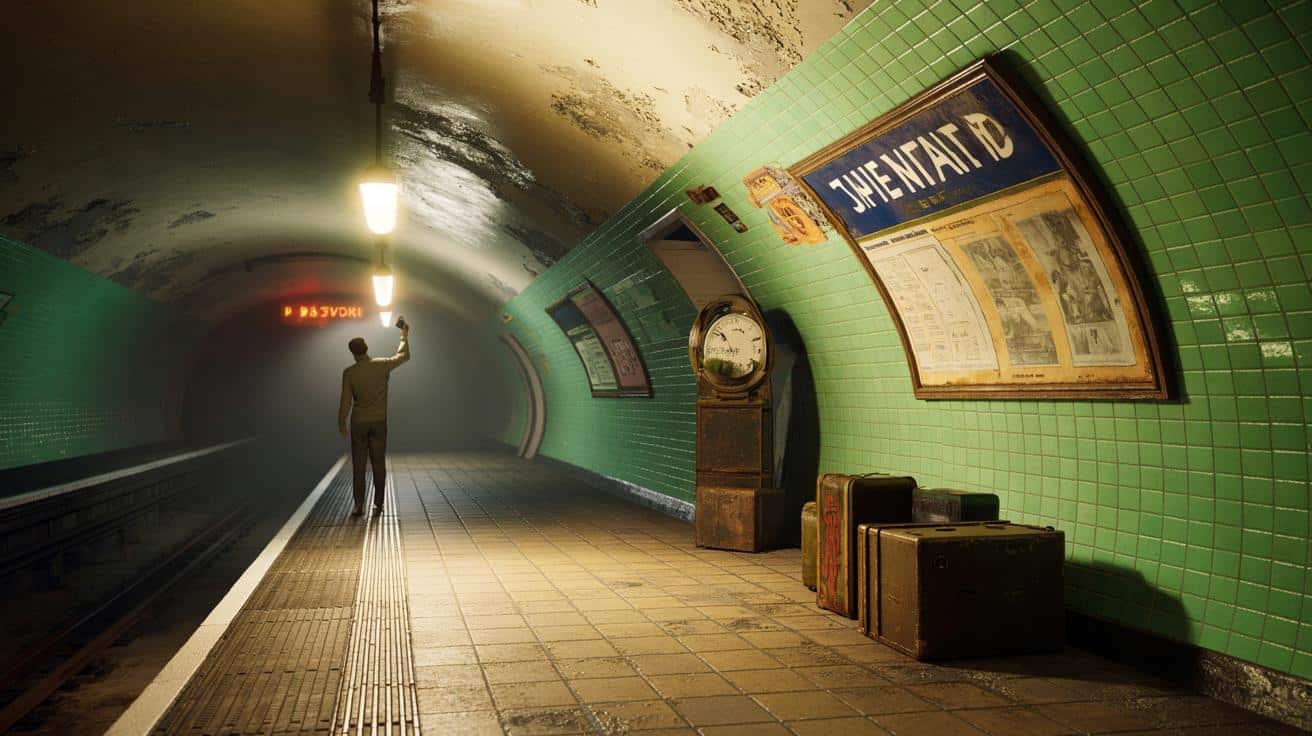
Beneath the Strand, behind a steel door and a short, echoing stairwell, sits an Underground station that closed its eyes in 1994 and never woke up. The city moved on. The tiles, the posters, the dust did not. What really lives down there when a station is left to its own silence?
The air changed first — cooler, mineral, a whisper of brake dust and old damp. Our guide’s torch skimmed the green-and-cream faience tiles, and the station’s original name — Strand — blinked back in enamel, like a ghost raising its hand.
We took the spiral staircase, counting the steps because you always count steps when there’s no window to the outside. At platform level, the light pooled in uneven bursts, revealing posters where the corners had curled like dried leaves. Somewhere above us, London hustled past with umbrellas and coffees.
The sound here was different. The city became a pulse, not a roar. The clocks are still wrong.
Aldwych: the ghost at the end of the branch
Aldwych is a station built on a shrug and shelved with care. Opened in 1907 as the stubby branch that never found its stride, it became a twice-an-hour shuttle to Holborn before the numbers thinned and the patience wore out. When the lifts needed replacing in the early 90s, accountants made the call that history often does — keep the money for busier lives upstairs.
Walk it now and you feel the hold of the place. The tiling glows softly where the electric light touches it, and the platform edges still carry that decisive white line that your feet avoid by instinct. You notice the old “STRAND” signs sitting proud, a reminder of the station’s first name, quietly rebellious beneath coats of time.
There are stories woven into the platforms that no timetable ever printed. During the Blitz, the tunnels sheltered people and more than people — crated treasures from the British Museum, including the Parthenon Marbles, rested here while incendiaries fell across the river. Imagine marble that had survived centuries now sharing space with flasks of tea and scuffed boots. **This is where London hid its treasures.**
Later, the station put on new costumes. Filmmakers came calling because Aldwych could pretend to be almost anywhere — the Tube without the fuss of passengers. Scenes from V for Vendetta, The Imitation Game, even music videos, borrowed its quiet for an hour and then left, the echo of action flattened back to dust.
The logic of its closure is plain, if unromantic. The branch was underused, its single platform and ancient lifts a maintenance headache, the route easily folded into a map already bursting with lines. Railways are practical beasts at heart, and Aldwych didn’t justify the feed. Time is patient underground.
What’s left is the odd alchemy of abandonment: a functional space becoming an accidental museum. It isn’t preserved in amber. Paint flakes. A drip sings in the same place, minute after minute. You sense how the Tube wriggles around its past, never quite able to cut it loose.
How to step inside without breaking the rules
If you’re curious, there’s a right way in. Book a Hidden London tour run by the London Transport Museum, and do it the day tickets drop, because they vanish quickly. Choose an off-peak slot if you can — early evening feels different down there, as if the platforms are exhaling after the top-side rush.
Wear shoes with grip and clothes you don’t mind dust greeting. Bring a camera that can work with low light, and learn one simple setting: bump the ISO, steady your hands, and aim for stillness. A small torch helps you read the enamel plates and period notices without bleaching them into glare.
We’ve all had that moment when a hush makes you feel more alive than noise ever could. Let’s be honest: no one actually does this every day.
“It’s not a theme park,” a guide told me with a grin. “It’s a working relic — treat it like a guest who’s older than you.”
- Tickets: Released in batches on the LTM website; sign up for alerts and move fast.
- Access: Expect stairs and uneven ground; there are no public lifts in operation.
- Photos: Tripods are often restricted; handheld shots are the rule.
- Etiquette: Stay behind lines, follow the guide, leave only footprints in the dust.
Why forgotten places stick in the mind
Standing on the platform, you realise how much of a city’s memory lives off to one side of the main road. Aldwych didn’t fail so much as it fell gently asleep, and the dreams it keeps are ours — safety during raids, a hiding place for art, a set for stories that needed tunnels. These walls held thousands of quiet moments that never made the news.
There’s also the simple thrill of it: peeking backstage. You learn the Tube is not only a diagram and a delay notice, but a handheld history of decisions, budgets, hopes, and human work. *I held my breath and listened for trains that never come.*
On the surface, buses hiss and coffees cool and emails fly. Down there, dust takes its time landing. **Time is patient underground.** It’s not just a station that time forgot. It’s proof that the city remembers in bones you rarely see.
Walk away and you keep checking the street grilles as you pass, half-expecting a thread of cold air on your ankles. You might tell a friend who sighs and says they’ve always meant to go, and you’ll nod because that’s how London operates. It hides its secrets in plain sight and waits for you to slow down long enough to notice.
Aldwych isn’t polished nostalgia. It’s a working compromise: closed to commuters, open to memory. The best kind of relic — one that lets you visit without pretending to be something it’s not.
You leave with dust on your cuffs and a small, private map in your head, where the Strand is not just a place above ground but a cool, tiled pocket beneath it. The city looks different after that. You do too.
| Key point | Detail | Interest for the reader |
|---|---|---|
| Hidden London access | Book official tours; limited releases and strict group sizes | Practical route to visit legally and safely |
| Wartime role | British Museum artefacts stored; shelter during air raids | Adds emotional and historical depth to the visit |
| Why it closed | Low ridership and costly lift renewals on a short branch | Helps make sense of the network’s past decisions |
FAQ :
- Where exactly is the entrance to Aldwych for tours?Meeting points change, but it’s typically near Surrey Street off the Strand. Your ticket email includes precise instructions.
- Is it safe to go into a disused station?Official tours are risk-assessed, supervised, and limited in size. You’ll follow marked routes and a guide trained for the site.
- Can I bring children?Age restrictions vary by tour. Many require under-16s to be accompanied by an adult, and some sites have minimum age limits due to stairs and conditions.
- Will I see trains?No active passenger services run through Aldwych. You’ll explore platforms, corridors, and features frozen from its working life.
- Are photos allowed?Usually yes, for personal use. Flash and tripods are often restricted; check your pre-visit email for specifics.




This made me shiver—in the best way. Never knew the Parthenon Marbles sheltered at Aldwych! Thanks for the low-light tips; bumping ISO is a life-saver for my wobbly hands. Do the Hidden London tours still forbid tripods, or is that site-specific? I’m definitley signing up next release.