
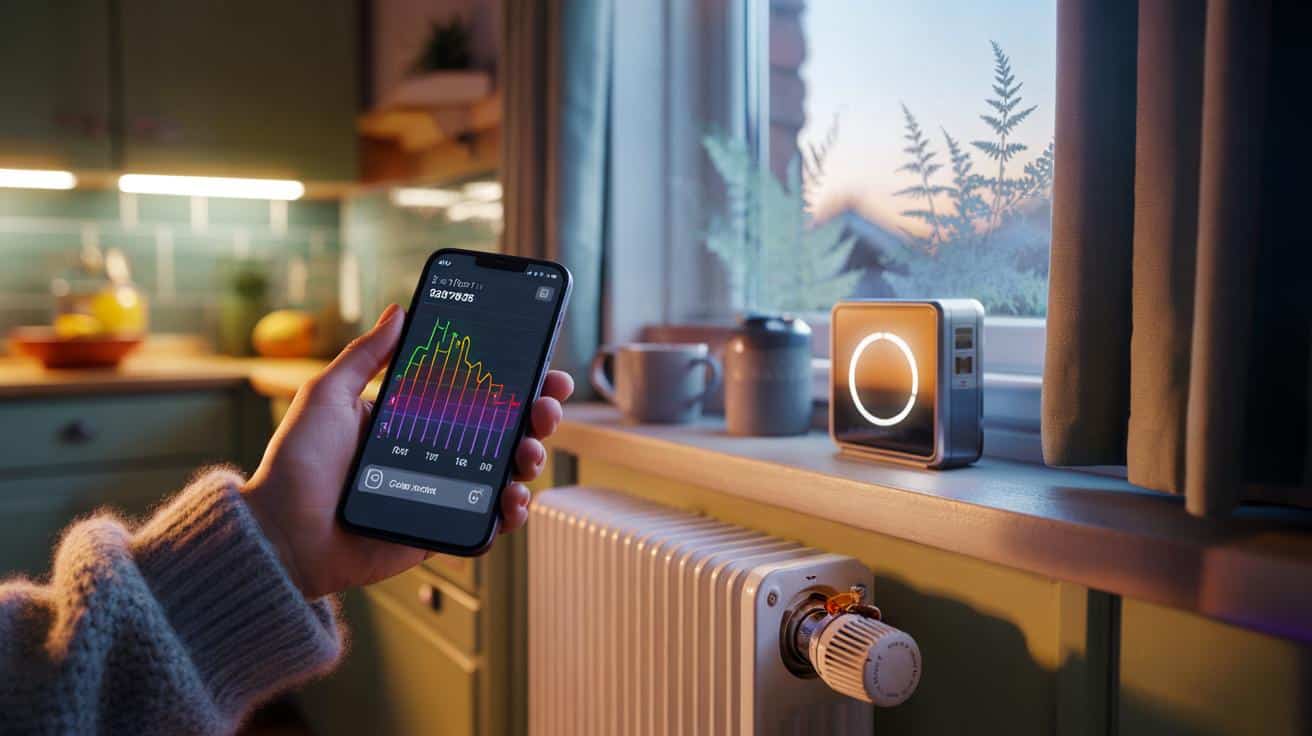
It’s 6.47am on a grey Tuesday and the kitchen tiles sting your feet, the thermostat winks, and you’re already doing the mental maths: leave the heating ticking along all day, or blast it at breakfast and again after dark. You scroll through your smart meter graph with one hand and pull your jumper down with the other, wondering if “low and constant” is thrift or myth while condensation sketches soft ferns on the window. What if the obvious answer is wrong?
The physics behind your bill
Here’s the bit your bank account quietly understands: heat loss is driven by the temperature difference between inside and outside. The warmer your rooms are for longer, the more heat drifts away through walls, windows and roof. **Heat escapes faster the warmer you keep your rooms compared to the air outside.** So when the heating stays on low for hours you’re paying to replace a steady stream of lost warmth, even while the house sits empty.
Take a simple, real-world trial. One London renter set her semi to 19°C for two morning and evening bursts in week one, then held a constant 16°C in week two. Her smart meter showed roughly a quarter less gas in the timed week, despite identical weather. Not a lab test, sure, but it mirrors what building engineers model: reduce the hours at higher temperatures and the total heat you need falls with it.
There’s a myth about “start-up surges” that guzzle gas when the system kicks in. The ramp is brief, and the boiler or heat pump still supplies only the heat your home loses across the day. What swings the total is the area under the curve of inside-vs-outside temperature. Lower it for longer and you spend less. Your home is a slow, breathing system, not a light switch.
The smart way to run your heating
Set a clear schedule and let automation do the steady work. Aim for a comfortable setpoint when you’re home — many Brits land around 18–20°C — then step back to 15–17°C while you sleep or when the house is empty. Fit and use TRVs so spare bedrooms idle cooler, keep doors closed, and drop your boiler’s flow temperature to 50–60°C so a condensing boiler condenses for longer. If you’ve a heat pump, go for small setbacks and long, gentle runs.
We’ve all had that moment when the chill sneaks under the door and you jab the thermostat to “max”, then forget it. That spikes comfort, not savings. Nudge don’t yank, and let the timer do the thinking, especially on workdays. Let’s be honest: nobody actually does that every day. If your place feels slow to warm, start the schedule 20–40 minutes earlier rather than keeping it idling all afternoon.
Think of the system as a team: the fabric keeps heat in, the controls decide when to add more. Draft-strip doors, close heavy curtains after dusk, and bleed radiators so they give full output. A small dehumidifier can make 18°C feel friendlier by drying the air a touch.
“Heat only what you need, when you need it, at the lowest comfortable temperature.”
- Lower boiler flow temperature to 50–60°C for gas condensing efficiency
- Use room-by-room TRVs and keep internal doors closed
- Schedule a 2–3°C night/away setback (1–2°C for heat pumps)
- Seal draughts, hang lined curtains, and insulate the loft
- Bleed and balance radiators each autumn for even heat
The final verdict
For most UK homes with gas boilers and typical insulation, leaving the heating on low all day costs more than running it in timed bursts with a modest setback. The physics is boringly consistent: less time at higher temperatures equals less total heat lost and less energy bought. **For a typical gas-boiler home, timed heating with a sensible set-back is the cheapest way to stay warm.** There are edge cases. Ultra-tight, well-insulated homes and heat pumps sometimes prefer gentle, near-continuous operation with small setbacks because the system sips rather than gulps and the fabric barely leaks.
The bigger lever is comfort at lower settings: close curtains at dusk, kill draughts, drop boiler flow temp, and warm the rooms you use, not the ones you don’t. Track a week on “constant low” versus a week on a schedule with your smart meter, same weather if you can. Share your graph. You might be surprised where the pounds go.
| Key point | Detail | Interest for the reader |
|---|---|---|
| Timed beats constant | Short, scheduled heating with a 2–3°C setback lowers the total heat loss across the day | Clear action that usually cuts bills without sacrificing comfort |
| Tune the system | Lower boiler flow temperature, use TRVs, bleed and balance radiators | Easy tweaks that unlock boiler efficiency and faster warm-up |
| Know your home | Insulation level and heat source matter; heat pumps like smaller setbacks | Avoid one-size-fits-all mistakes and tailor settings to your place |
FAQ :
- Is it cheaper to leave the heating on low all day?In most boiler-heated homes, no. A timed schedule with a modest setback uses less energy because your house spends fewer hours at a higher temperature, so it leaks less heat overall.
- What temperature should I set at night?For boilers, a setback to around 15–17°C works well for many households. For heat pumps, go smaller — often just 1–2°C — to keep long, efficient runs without big reheat times.
- Does turning the heating off cause damp or mould?Damp comes from moisture and cold surfaces. Manage humidity with extraction in kitchens/bathrooms and reduce draughts, then warm rooms when occupied. Avoid letting rooms sit cold and wet for days.
- What about underfloor heating?UFH has thermal mass, so it prefers steady, longer cycles. Use small setbacks and anticipate by starting a bit earlier, especially with heat pumps. With boilers, you can still schedule it, just avoid big swings.
- How do I know my condensing boiler is working efficiently?It condenses best when the return water is below roughly 55°C. Lower the flow temperature to 50–60°C, check for steady flue vapour in cold air, and see if comfort holds while usage nudges down.







Finally, a clear answer—timers beat “constant low” for most boilers. Dropping my flow temp to 55°C saved me ~12% last winter. Cheers for the TRV tip!