
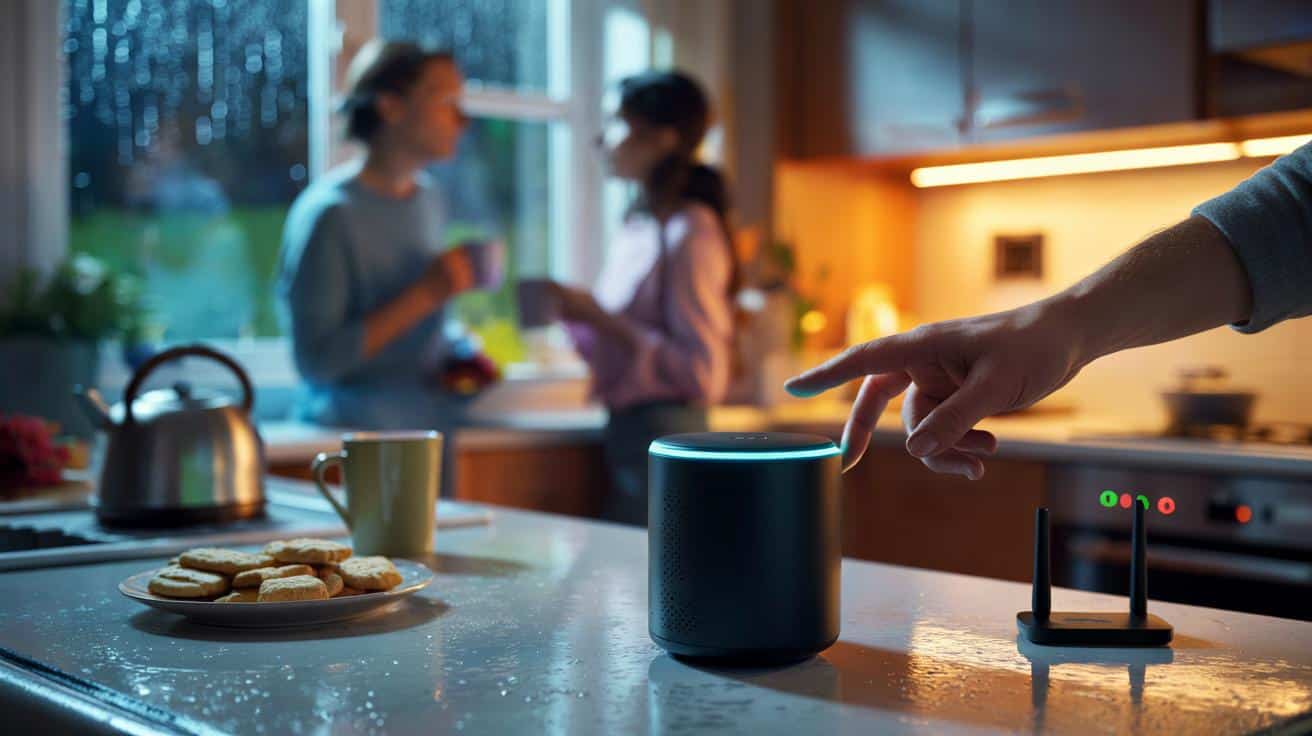
That neat cylinder on your kitchen counter, sat there like a polite guest, promising timers and playlists and the weather in Bath. But the nagging thought keeps returning: is it just hearing you, or is it listening?
It happened in a friend’s flat, a tiny London kitchen where the kettle whistled and rain ticked at the window. We were swapping stories about job interviews, the sort of raw, hopeful chat you only have over mugs and biscuits. The smart speaker on the worktop did nothing, a silent spectator with a glowing ring. Then, out of nowhere, it flickered, hummed into life, and offered a definition for a word none of us had said. We froze, mid-sip. A laugh, because what else can you do? Later, walking home, the thought snagged again. What did it hear before it woke? And what did it send?
Is it really listening when you don’t ask?
Smart speakers work like watchful doormen. They keep a tiny loop of sound in memory, waiting for a trigger — the **wake word**. When they think they hear it, they clip a short audio snippet from just before and after, then usually send that to the cloud for processing. That’s the basic contract: local vigilance, cloud brains. Most of the time, the data stays on your table, not in a data centre. The catch lives in the word “most”.
False wakes are the gremlins. We’ve all had that moment when a speaker lights up during a film or halfway through a family story. Researchers have recorded assistants misfiring on words and phrases that only vaguely resemble “Alexa” or “Hey Google”. Real life is messy; accents stretch vowels, TVs blur consonants, music muddies speech. That mess triggers devices to perk up and, at times, send short recordings you never meant to share. It’s not constant surveillance. It is a series of little stumbles.
There’s also the human factor. In 2019, reports revealed that snippets from voice assistants were sometimes reviewed by contractors to improve accuracy. After the backlash, major brands shifted to opt-in or clearer settings, and many disabled human review by default. The practices vary by company and region, and policies change. Under UK and EU law, you have rights to see, download, and delete your data. The headline truth: the machine isn’t an eavesdropper in the cinematic sense, but mistakes and policies can turn convenience into exposure.
How to keep your speaker useful without oversharing
Start with placement. Put the device where chatter is purposeful — kitchen worktop, living room shelf — not the bedroom or near your desk during video calls. Distance matters, too. A metre or two from the TV lowers the chance of misfires from dialogue. If your model has a hardware mute switch, use it during dinner parties or when you need privacy. A red light beats second guessing. And if you can, train the voice model to your accent in the app; it reduces the chance of your device waking for the wrong reasons.
Next, prune your archive. Most platforms let you set auto-delete for voice recordings at 3, 18, or 36 months, or turn off saving altogether. Dip into your history monthly and clear anything sensitive. You can also disable “help improve the service” toggles that allow human review. While you’re in there, lock down voice purchases with a PIN and switch off personal results on shared devices. Let’s be honest: nobody does that every day. But ten minutes once a season can spare you years of odd wake-ups and awkward ads.
Network hygiene helps more than you think. Put smart home gadgets on a guest Wi‑Fi or a separate router SSID, so they’re not mingling with your laptop and work files. Many modern routers let you block outbound connections to unknown domains, set schedules, and see when a device talks to the internet. If you notice activity at 3 a.m. when the house is quiet, that’s a clue to investigate. Yes, it can feel creepy.
“Think of a smart speaker like a microphone you’ve invited home. Give it boundaries, and it’s brilliant. Let it roam, and it will surprise you.”
- Disable saving voice recordings, or set auto-delete to 3 months.
- Use the hardware mute during private chats or calls.
- Place the device away from TVs and thin walls.
- Create a guest Wi‑Fi for smart home gear; review router logs monthly.
What’s actually being stored — and how to read the small print
Your commands, timestamps, and sometimes related metadata can live in your account history. That might include which household profile spoke, what music service was queried, and whether the request was understood. Brands insist wake-word detection is local, with clips sent only after activation, including a few seconds of audio before the wake. This short buffer is how the cloud figures out what you truly meant. The system is efficient, but it’s also why accidental wake-ups matter.
Policies have tightened since those 2019 revelations about human reviewers. By default, many assistants now process recordings with automated systems and ask you to opt in if you want to “help improve” with human checks. In the UK, the ICO (the data watchdog) expects clear consent and easy deletion. You can export your voice history and see exactly what was captured. If a clip feels too intimate, delete it, then adjust settings so the same miss doesn’t happen twice. **Accidental wake-ups happen** — the smart bit is what you do after.
There’s also a shift towards on‑device processing. Newer speakers and phones can handle simple requests locally — timers, alarms, smart bulbs — and only ping the cloud for heavyweight tasks like searching the web or playing a specific podcast. That reduces what leaves your home. If privacy ranks high for you, choose devices that advertise local voice processing and clear hardware mics-off controls. And teach everyone in the house the basic rules: where the mute button is, what the wake word is, and which features you’re comfortable using. **Always listening vs always recording** is not just technical — it’s cultural.
Where this leaves us
A smart speaker is part butler, part butterfly effect. A tiny word, a half-heard phrase, and an action ripples out — a light turns on, a message is sent, a recording is stored. There’s power in that ease, and a cost in the ambiguity. You don’t need to wrap your gadget in tinfoil or throw it in a drawer. You might just move it to a wiser spot, trim the history it keeps, and draw a clean line between what’s meant to be heard and what belongs to the room. Share these boundaries with the people you live with. Privacy works best as a house rule, not a solo project.
| Key point | Detail | Interest for the reader |
|---|---|---|
| Wake words rule the flow | Audio is buffered locally; clips are sent after activation with a few seconds before and after | Demystifies when your voice actually leaves the room |
| False wakes are normal | Similar-sounding phrases, TV dialogue, and accents can trigger misfires | Explains why the light blinks at odd moments — and how to reduce it |
| Settings change the game | Auto-delete, mute switch, guest Wi‑Fi, and opt-outs reduce exposure | Practical steps to keep convenience without oversharing |
FAQ :
- Does my speaker record everything I say?No. It listens locally for a wake word and typically sends audio to the cloud only after activation, including a short pre-roll.
- Can employees listen to my recordings?Some brands previously used human reviewers to improve accuracy; today many require opt-in and offer clear toggles to disable review.
- How do I stop accidental activations?Move the device away from TVs, retrain voice settings, and use the hardware mute during chats or calls.
- Can I delete past voice recordings?Yes. You can review and delete them in your account, and set auto-delete to trim future history.
- Is local processing better for privacy?Often, yes. Tasks handled on-device mean fewer clips leave your home; look for models that highlight on-device voice features.







Great breakdown. The distinction between local wake-word listening and cloud processing finally makes sense, and the bit about false wakes rings true. I’ve set auto‑delete to 3 months and moved mine off the TV, plus a guest Wi‑Fi. Feels like practical privcay, not paranoia.
If clips before the wake word get sent, isn’t that still recording us—just sneakier? The “most of the time” caveat makes me wary. Policies change, and so do defaults; opt‑in today, opt‑out tommorow?